Key TakeawaysPutting AI to work does not mean digitalising everything. It starts with the data already being collected.
Whole-system optimisation in logistics can be achieved only between players with different interests, and the key is to take it to a neutral third party such as a university.
Contents
- Event overview
- The "whole" in whole-system optimisation
- Nexgen View
- Closing
- References and key sources
1. Event overview
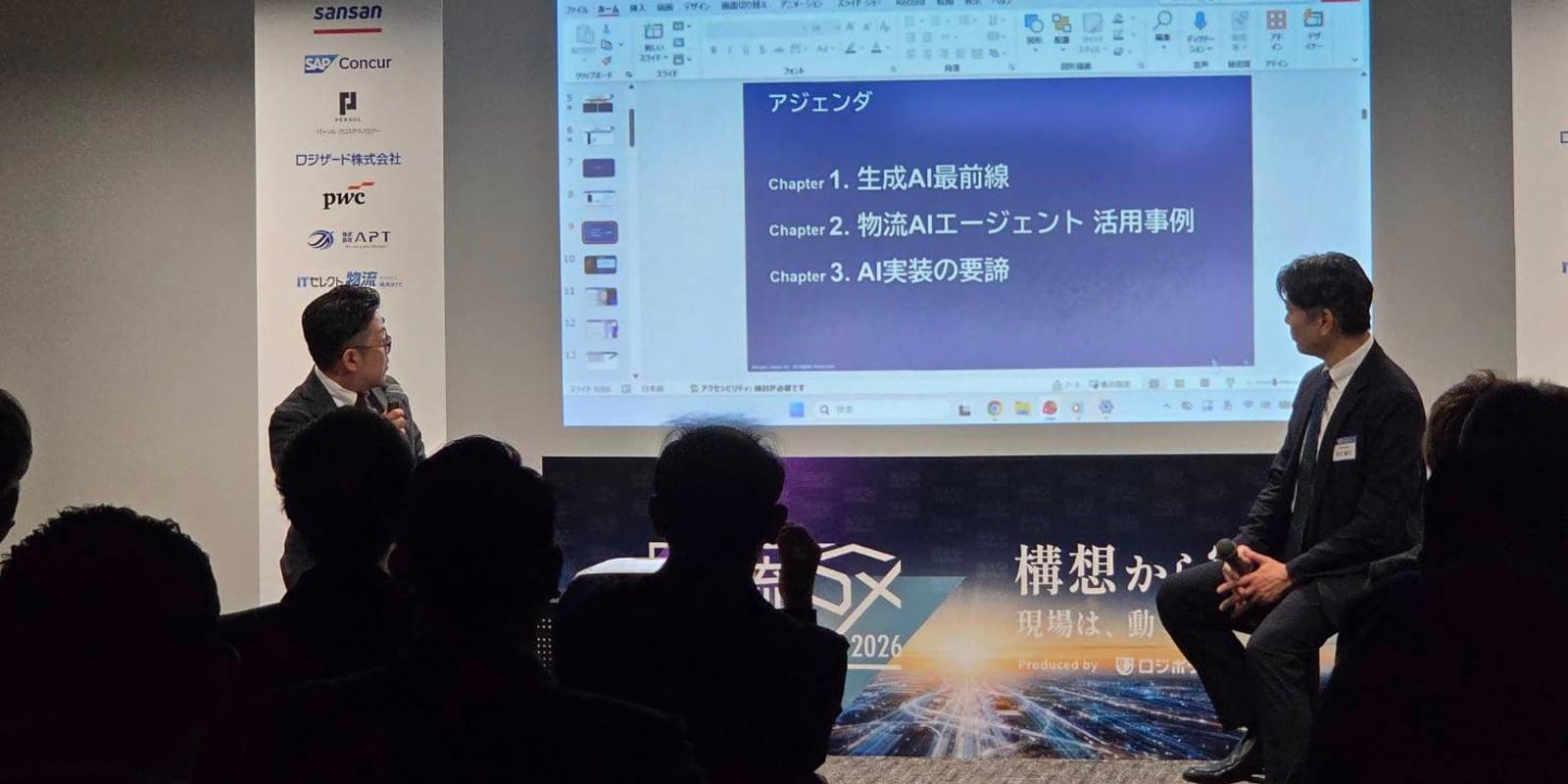
Ariki Ono, chief executive and Logistics AI Architect at Nexgen Japan, appeared in conversation with Professor Kenji Tanaka of the Department of Technology Management for Innovation at the University of Tokyo's Graduate School of Engineering on 11 November. The session formed part of the Logistics DX Future Conference 2026, organised by X Mile in co-operation with LOGISTICS TODAY at Otemachi Place Hall & Conference in Tokyo. We announced the session on 5 November.
The session was titled "The Front Line of Logistics AI (DX): Supply Chain Optimisation Starts with Writing Down the Data".
Professor Tanaka researches logistics and transport at the Transport Innovation Research Center, which is attached to the graduate school. The centre also runs a recurrent education programme in supply chain management for working professionals.
2. The "whole" in whole-system optimisation
Whole-system optimisation gives different answers depending on where the boundary of the "whole" is drawn. If the unit is the shipper, Professor Tanaka said, the answer is to maximise the shipper's profit; if it is the haulier, the answer is to maximise the load factor of each run. An optimum can be calculated for any unit. It is not necessarily the optimum for society. A company optimising its own whole will rarely co-operate with others at the cost of its own share.
Nexgen Japan likewise doubts that two organisations can each deploy an AI agent, let the agents negotiate and leave plan optimisation to them. What sales and logistics agents can produce with a solver is a list of options that satisfy the constraints (our report of 6 October). Whether this is a moment to win the trust of a new customer or to protect the margin is context that no database holds. Professor Tanaka called this "the limit of data". In other words, the data that is not in the database is what holds the key to the best decision.
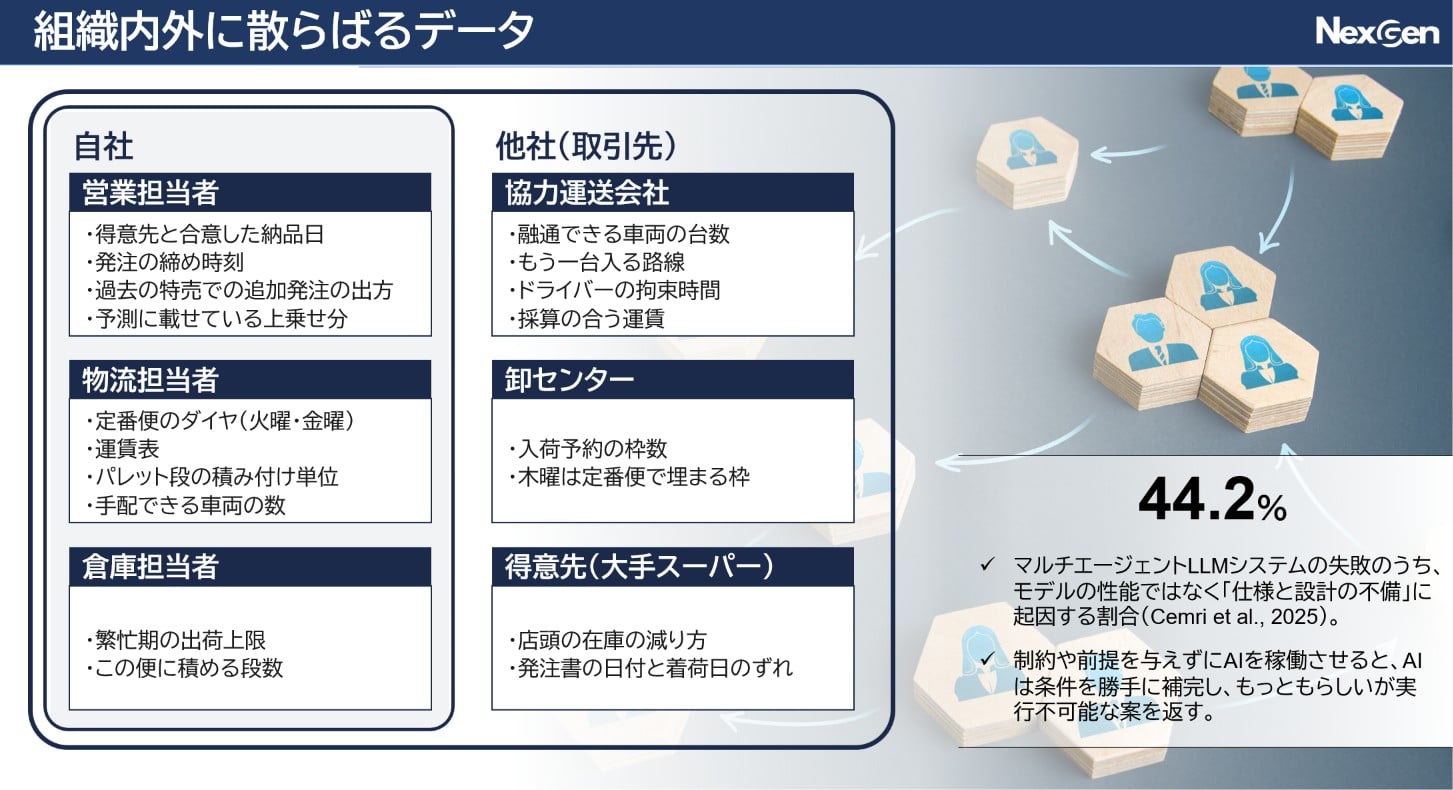
Figure: Data scattered inside and outside the organisation (from Nexgen Japan's session slides)
3. Nexgen View
3-1. Deliver results through the channels the site already uses
The session featured a demonstration video in which a graduate of Professor Tanaka's laboratory had built an "AI centre manager". The system refreshes data from across the warehouse every 15 minutes; when it spots a process likely to delay shipments, the AI telephones the supervisor on site and tells them how many staff to redeploy. The point stressed was that the channel of communication is the telephone, not a screen.
What matters when applying AI on a logistics site is whether the result can be turned into an operation people can sustain. Rather than spending time perfecting the accuracy of the AI, delivering a result that is 80% right, quickly and in a form people grasp at once, is what keeps operations running. Sites that run on paper forms should get paper forms; sites that run on radio should get voice. Projects that introduce systems where none is needed, and then require staff to learn them, will never take hold on the front line.
3-2. Observe the site first, then go after the missing data
There is no need to gather every piece of data before starting. Issue instructions with the data already available and the site will report back why they could not be followed. Only then does it become clear what data was missing.
Suppose drivers hand down a rule: do not deliver between 12:00 and 13:00. As a rule, the reason, that the customer is a restaurant which cannot accept goods during the lunchtime service, is written down nowhere. Investigate such circumstances for each delivery address and build them into the routes, and even a new driver can work efficiently. This, Professor Tanaka said, is exactly the kind of theme his laboratory is pursuing. Veterans' handed-down rules are the archetype of data that can be found only by observing the site.
3-3. Take the problems no one can raise internally to a university
Cutting inventory, avoiding lost sales from stockouts and improving transport efficiency: these three sit with different departments and are classic examples of goals that pull against each other. Staff may see the direction of a solution, yet find it hard to raise with other departments or business partners.
More than half of the laboratory's research, Professor Tanaka said, is conducted with companies. One example is the validation of a production plan in which only 80% of forecast demand for goods made overseas is produced in the first run, with the remaining 20% added according to sales. A university can test ideas, failures included, before they are implemented, and can frame problems from the perspective of the whole industry rather than a single company. It can also estimate the effect of collaboration between companies that would not normally work together.
Nexgen Japan believes industry-academia collaboration should be used not as a venue for exchanging people, but as a way to move problems that cannot be moved inside the company, through calculations made by a third party.
4. Closing
First, deliver the data already in hand through channels the site is used to, then go after the next data. Along the way, observe the site and look for data that has never been put into words. That is the order in which Nexgen Japan brings AI to logistics operations. Beyond that, whole-system optimisation is achieved only between players with different interests, and the key is to take it to a third party such as a university.
We would like to thank Professor Kenji Tanaka for joining the conversation, X Mile for planning and running the conference, and everyone who came to the first session of the morning.
5. References and key sources
- X Mile, "Logistics DX Future Conference 2026: From Concept to Implementation. Will the Front Line Move?" (in Japanese)
- X Mile, "Announcement of the Logistics DX Future Conference 2026" (in Japanese)
- Department of Technology Management for Innovation, Graduate School of Engineering, University of Tokyo, "Faculty profile: Kenji Tanaka" (in Japanese)
- LNEWS, "University of Tokyo launches SCM talent development programme, with online briefings in August and September" (21 August 2026, in Japanese)
- Nexgen Japan, "Logistics DX Future Conference 2026: AI agents put a price on conflict, says Nexgen Japan's Ariki Ono" (6 October 2026)
Questions we often receive from practitioners
To use AI on a logistics site, do we first need to gather all the data?
No. It is quicker to issue instructions to the site using data already held in the warehouse management or order systems, then collect the reasons why staff could not follow them. Among those reasons you will find information that is not in any system, such as the hours when a delivery address cannot accept goods.
We have built dashboards, but front-line staff do not look at them. What should we do?
Stop designing for people to come and look, and design for results to reach them instead. Routines that require someone to open a screen and check it every day do not last on most sites. Send summaries automatically at fixed times, or alert the person in charge by phone or voice when a process is about to fall behind, using the channels the site already relies on. Where a site runs on paper forms, deliver results on paper forms.
What is the advantage of taking a logistics problem into joint research with a university?
It allows problems that are hard to raise inside the company or with business partners to be tested from a neutral position. Cutting inventory, avoiding stockouts and improving transport efficiency sit with different departments that pull against each other, so the parties alone rarely make progress. A university can frame the problem without taking any one company's side, and can test ideas, failures included, before anything is implemented. It can also estimate the effect of collaboration between companies.
Get in touch
Turn the data you already have into instructions for the front line
Nexgen Japan supports clients with work such as introducing AI agents to coordinate delivery terms between sales and logistics, and writing down the tacit knowledge held by front-line staff as data.
Contact us →