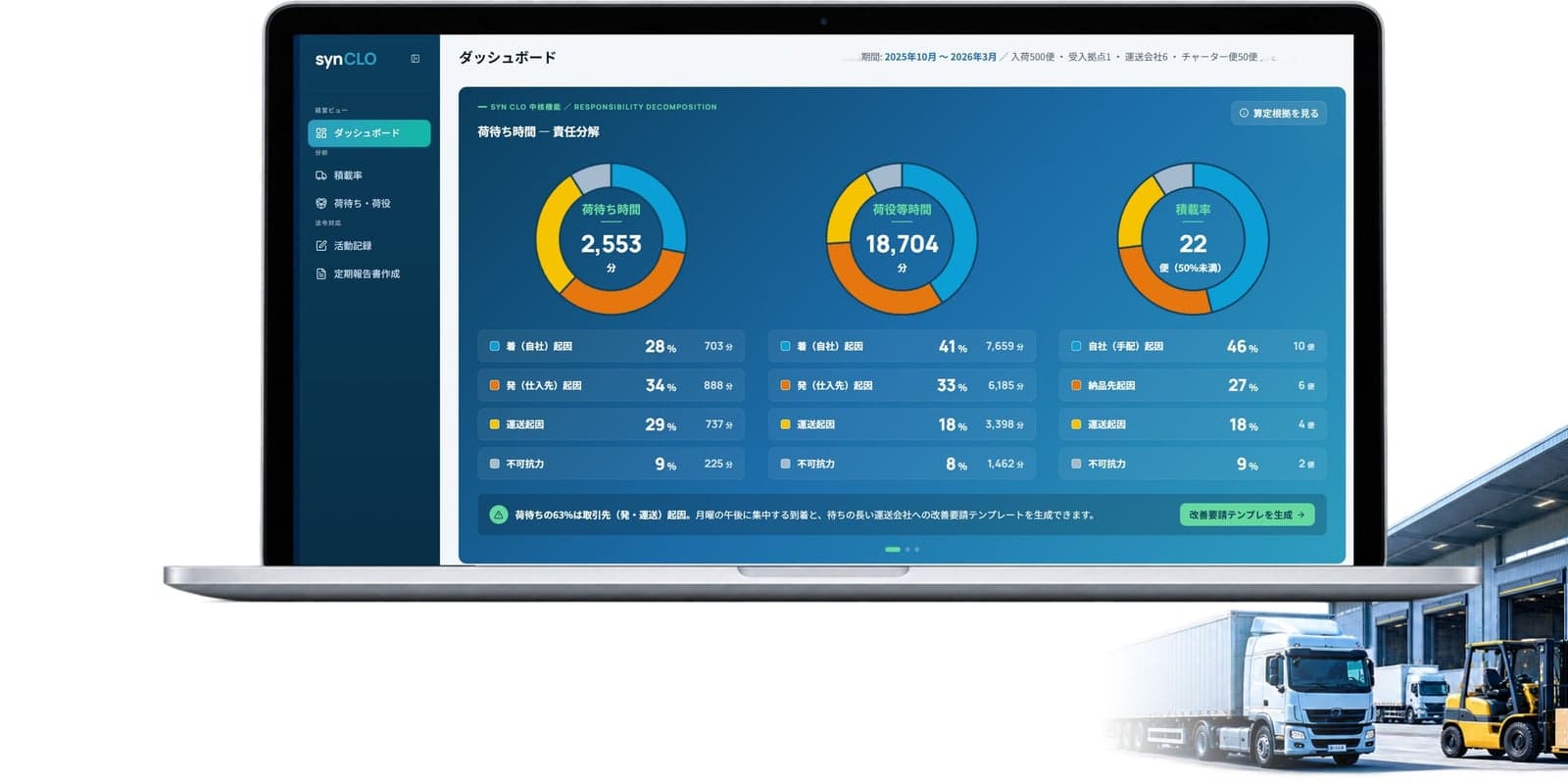
Nexgen Japan Inc. (headquarters: Yokohama, Kanagawa; CEO: Ariki Ono), Fujitex Co., Ltd. (headquarters: Nakano, Tokyo; President: Yusuke Ichimori) and Selfit Inc. (headquarters: Shinjuku, Tokyo; CEO: Noriya Usami) announced on 4 November 2026 that they have joined forces and begun a proof of concept (PoC) to diagnose and improve companies' supply chain management (SCM).
Japan's "2024 Problem", the squeeze on haulage capacity that followed new limits on lorry drivers' overtime, together with the revised Logistics Efficiency Act, has made a review of supply chains an urgent task for many companies. By pooling their expertise, the three companies aim to make each client's logistics and SCM performance, and the problems within it, visible, and to test a service that supports the whole journey from weighing up improvements to putting them into practice.
Contents
- Background and aims
- What the project will do
- The problems it addresses
- Comments from the three companies
- Next steps
- Company profiles
- Media enquiries
1. Background and aims
Pooling the expertise of three specialists to make operations visible from the ground up, rather than on paper
Solving problems across a supply chain requires a view of the whole, from the location of distribution centres to last-mile delivery. Yet it is difficult for a single company, or an off-the-shelf system, to build something that reflects how sites actually operate.
The three companies each bring distinct strengths and track records in a different part of logistics: improving operations on the ground, delivery infrastructure, and AI and other information technology. Together they have set up a partnership designed to link operational data directly to management decisions.
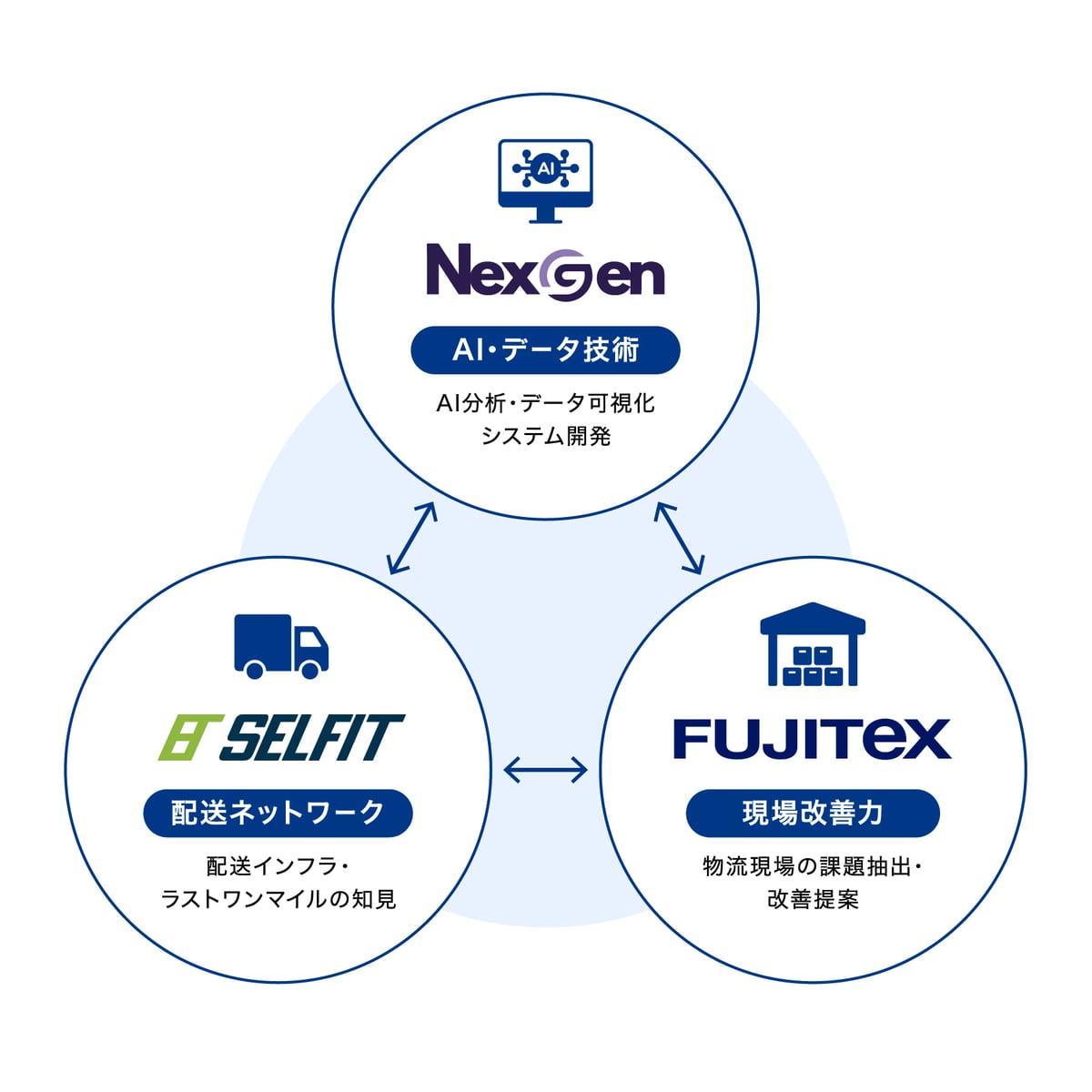
Figure: How the three companies divide their roles (labels in Japanese)
Roles of the three companies
- Nexgen Japan (AI and advanced digital technology): Drawing on AI development and a data analytics platform built for logistics, it turns complex data scattered across sites into a system that lets executives make decisions intuitively.
- Fujitex (identifying and fixing problems on site): Building on some 40 years of work in logistics and industry, it spots the real problems in materials, equipment and operations, and devises improvements that sites can actually put into practice.
- Selfit (delivery infrastructure and operational know-how): With strengths in building next-generation delivery infrastructure and hands-on experience of last-mile delivery, it makes possible a practical analysis that takes account of the constraints and realities of delivery, not just the shipper's side.
By combining these perspectives, the companies intend to go beyond chasing numbers in the data, produce analysis that fits how sites really work, and build a practical system that lets executives decide quickly.
2. What the project will do
The PoC will focus on two areas.
2-1. An AI-driven SCM management diagnostic and improvement proposals
The companies will diagnose the whole supply chain and identify where the bottlenecks lie. They will propose realistic improvements based on actual operational data and work alongside each site until the changes take hold.
2-2. synCLO, a dashboard for Chief Logistics Officers (CLOs)
The companies will develop and test a dashboard that lets executives grasp the state of their supply chain at a glance and use it in decision-making. Given how varied logistics operations are, they will build a flexible way of collecting data that can cope with many different situations, and organise complex logistics data so that it is easy to understand.
- Indicators required by the revised Logistics Efficiency Act: The dashboard will visualise the three indicators the revised Act requires companies to track, namely waiting times, loading and unloading times and load factors, as well as measures tailored to each company's own management issues.
- Support for periodic reports: The companies will reduce the work involved in preparing the periodic reports required under the revised Act, from automatic data aggregation through to drafting the report.
3. The problems it addresses
The partnership and the PoC are intended to help companies facing problems such as these in their supply chains.
- Logistics as a black box: Having outsourced their logistics wholesale to third parties, companies can no longer see what is happening on the ground or how day-to-day operations are going.
- Slow progress towards overall optimisation: Data is split between sites and departments, so there is no shared view of the whole supply chain and little coordination across it.
- Uncertainty over compliance: Companies have yet to settle on a method or a starting point for visualising and reporting waiting times, loading and unloading times and load factors, as the revised Act requires.
4. Comments from the three companies
Ariki Ono, CEO and Logistics AI Architect, Nexgen Japan Inc.
At Nexgen Japan, we aim to hand logistics, a piece of social infrastructure, on to the next generation by developing systems that combine SCM and AI. We do not want compliance with the revised Act to end with filing a report. Figures for waiting times, loading and unloading, and load factors are material for a conversation about improvement. By using AI to tidy up data scattered across existing systems, and showing the causes from the standpoint of the consigning shipper, the receiving shipper and the haulier in turn, we want everyone involved to look at the same numbers and agree on what to change. We will start by making the system work on Fujitex's own sites, and develop it together with Selfit.
Yusuke Ichimori, President, Fujitex Co., Ltd.
The 2024 Problem and the change in the law are pressing issues for us too, as a trading company. Developing the CLO dashboard and the SCM management diagnostic through this partnership is, first and foremost, a practical effort to solve our own logistics problems, and we will apply what we learn directly to our customers' problems. By combining the specialist expertise of our two partners with our own strength in improving operations on site, we aim to become a "solution platformer" that addresses our customers' management challenges at the same time.
Noriya Usami, CEO, Selfit Inc.
Selfit is a start-up that sets out to solve the next generation of logistics problems, drawing on the experience of Celute, which has supported logistics from the delivery side for many years. The logistics industry faces many challenges, including labour shortages, rising fuel costs, the growth of e-commerce and smaller shipments, and decarbonisation. We see this partnership as a first step towards going beyond the confines of delivery, making the whole supply chain visible, and working out and putting into practice, together with our customers, the kind of logistics that will sustain the 21st century.
5. Next steps
As the first step, the companies are running the PoC and measuring its effects using data from Fujitex's own logistics operations.
They are preparing to launch a Logistics DX Assessment for the SCM management diagnostic and the CLO dashboard in December 2026, and are inviting companies to join them in the PoC.
6. Company profiles
Nexgen Japan Inc.
| Item | Details |
|---|---|
| Company | Nexgen Japan Inc. |
| Representative | Ariki Ono, CEO |
| Address | Wizard Building 402, 1-4-3 Sengen-cho, Nishi-ku, Yokohama, Kanagawa |
| Business | AI system development, applications and talent development for SCM and logistics |
| Website | https://nexgen.co.jp/en |
Fujitex Co., Ltd.
| Item | Details |
|---|---|
| Company | Fujitex Co., Ltd. |
| Representative | Yusuke Ichimori, President |
| Address | Sumitomo Fudosan Nakano Ekimae Building 20F, 2-24-11 Nakano, Nakano-ku, Tokyo |
| Business | Sales promotion, environment, logistics, energy, GX and other businesses |
| Website | https://fjtex.co.jp/ (in Japanese) |
Selfit Inc.
| Item | Details |
|---|---|
| Company | Selfit Inc. |
| Representative | Noriya Usami, CEO |
| Address | Takadanobaba Center Building 2F, 1-31-18 Takadanobaba, Shinjuku-ku, Tokyo |
| Business | Operation of the DIAq delivery-matching service, and logistics and everyday-life support services that use IT-driven matching |
| Website | https://selfit.inc/ (in Japanese) |
7. Media enquiries
Nexgen Japan Inc.
- Email: contact@nexgen.co.jp
- Enquiries: contact form
Frequently asked questions
What must shippers track under Japan's revised Logistics Efficiency Act?
The revised Act requires shippers to track three indicators: waiting times, loading and unloading times, and load factors. Designated shippers must also submit periodic reports. synCLO, the CLO dashboard being developed by the three companies, will visualise these three indicators, together with measures tailored to each company's own management issues, and reduce the work involved in everything from automatic data aggregation to drafting the reports.
What does the SCM management diagnostic involve?
It uses AI to diagnose the whole supply chain and pinpoint where the bottlenecks lie. It then proposes realistic improvements based on actual operational data and supports the site until the new ways of working take hold.
Which companies is the initiative aimed at?
Companies that have outsourced their logistics wholesale and lost sight of what happens on the ground; companies whose data is split between sites and departments, so that no one has a clear view of the whole supply chain; and companies that have yet to settle on a method or a starting point for visualising and reporting waiting times, loading and unloading times and load factors, as the revised Act requires.
How can a company take part in the PoC?
The three companies are preparing to launch a Logistics DX Assessment for the SCM management diagnostic and the CLO dashboard in December 2026, and are inviting companies to join the PoC. Please get in touch through Nexgen Japan's contact form or by email at contact@nexgen.co.jp.
Join the PoC
We are looking for companies to take part in the Logistics DX Assessment
We are preparing to launch the Logistics DX Assessment in December 2026 and are looking for companies to join the PoC for the SCM management diagnostic and the CLO dashboard. If you are grappling with visualising waiting times, loading and unloading times and load factors, or with the periodic reports, please get in touch through our contact form.
Contact us →