
Key Takeaways from the TalkAI agents can narrow a dispute between sales and logistics to a handful of mathematically sound options. Choosing between them, in line with company policy and the state of a customer relationship, remains a job for people.
Generative AI can now fill gaps and inconsistencies in messy data. Companies that read incoming faxes with AI will digitalise faster than those waiting for the fax machine to disappear.
Contents
- Event overview
- The demonstration: sales and transport agents strike a deal
- Nexgen View
- Closing
- References and key sources
1. Event overview
Ariki Ono, chief executive and Logistics AI Architect at Nexgen Japan, spoke at the Logistics DX Future Conference 2026 AFTER ACTION IN TOKYO on 2 October, a special programme within the Logistics DX EXPO at the Industrial DX Expo 2026 Summer Tokyo, held at Tokyo Big Sight. We announced the talk on 17 September.
The session, titled "Agents Put a Price on Conflict: Where Logistics AI Implementation Stands Today", was moderated by Yusuke Akazawa, chief executive and editor-in-chief of LOGISTICS TODAY, which reported on the session (in Japanese).

Photo: Ariki Ono speaking at the Logistics DX Future Conference 2026 (Photo: LOGISTICS TODAY)
This report sets out the main points of the talk and our view on them.
2. The demonstration: sales and transport agents strike a deal
Ono demonstrated synPATH, Nexgen Japan's logistics AI agent, in which an agent acting for the sales department and another acting for logistics trade conditions to agree a delivery plan.
Each agent reads its own department's data. Within a few rounds of exchange, the two found 24 combinations that met every constraint. They then ran a solver, an optimisation tool, to narrow these to three options that balance stockout rates against logistics costs.
The trade-offs were plain. The option that best served sales targets cost the most; the one that best served logistics targets carried the highest risk of stockouts.
The agents can produce well-balanced options, but they cannot tell whether a customer will accept them. For that reason, synPATH lets people enter the final decision themselves. Whether the priority is to build trust with a retailer that has just listed a product, or to protect margins, is context that sits in no database. People make that call.
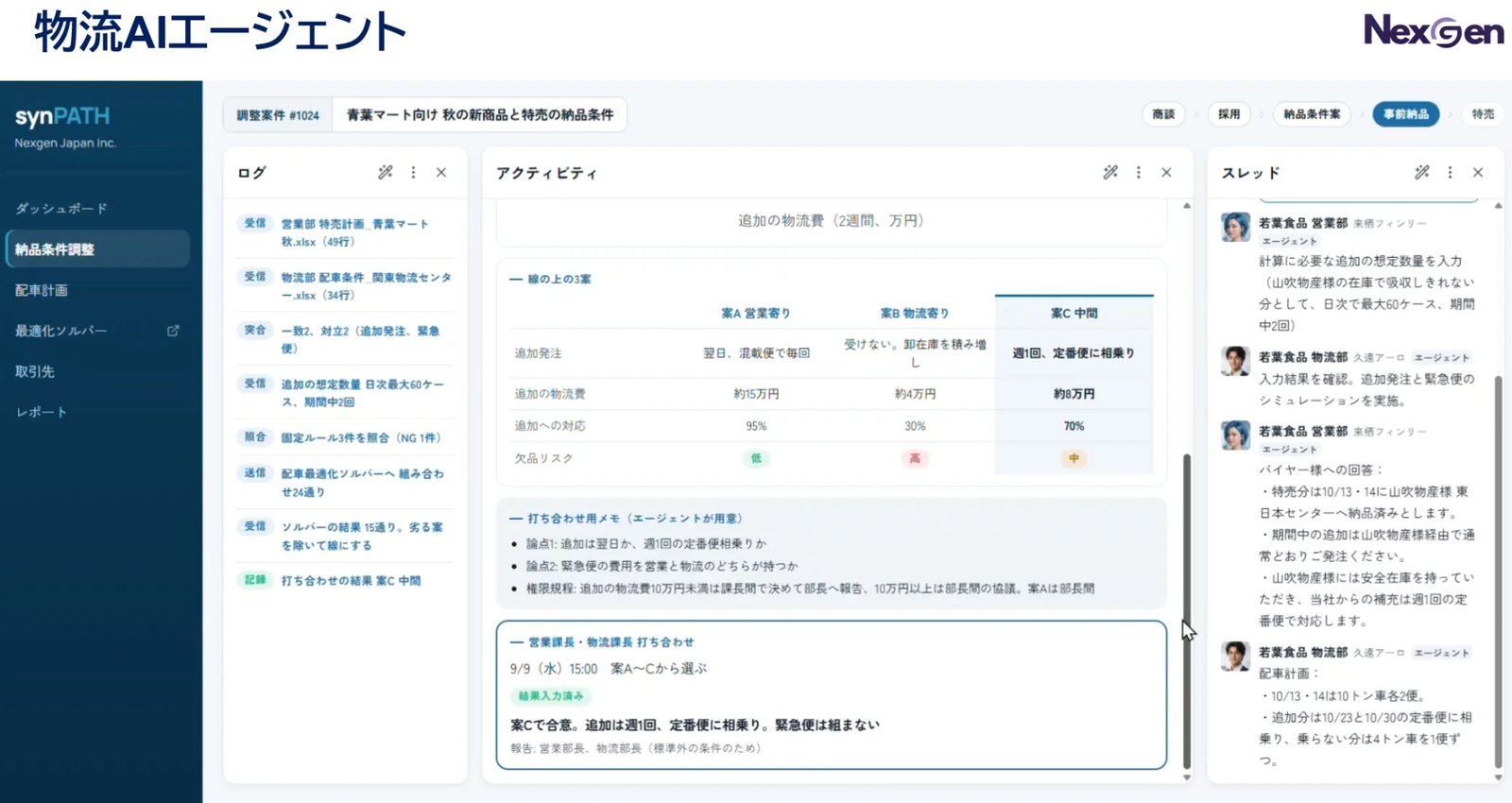
Figure 1: Sales and logistics agents coordinating delivery terms (Nexgen Japan's synPATH)
3. Nexgen View
3-1. Keep the fax and let AI read it
Japan's logistics industry still runs on fax. Akazawa put the problem squarely.
Yusuke Akazawa, chief executive and editor-in-chief, LOGISTICS TODAY
While collaborative logistics is advancing, terminology and data formats have gone unstandardised for years, and fax is still widely used between shippers and carriers. Some data suggest more than 90 per cent of companies use it. That is one of the things holding back digitalisation and the use of AI.
Ono's answer was blunt.
Ariki Ono, chief executive, Nexgen Japan
There is no need to get rid of fax.
Must the industry abolish the fax machine before it can use AI? We think not. The conventional sequence, standardise first and automate later, has kept logistics waiting for years. Generative AI reverses it. A model that can read a faxed order and turn it into a shipping instruction makes the format of the paper far less important.
The reason is that logistics is a business of exceptions: formats that vary by customer, handwritten additions, rules of thumb that live in one clerk's head. Older software choked on them. Generative AI can now fill gaps and inconsistencies in data, and recognise an exception as an exception. Companies that put it to work on the faxes they already receive will digitalise faster than those waiting for the fax to die.
Case in point
Marubeni Logistics runs order processing and logistics for a rice-cracker maker with sites in Niigata Prefecture. About 30 per cent of the maker's orders arrive by fax, in formats that differ by customer and often include handwriting, which conventional OCR struggled to read.
Working with Marubeni's Digital Innovation Department, the company now reads fax purchase orders with OCR, has generative AI convert them into data in a standard format, and leaves staff only to check and correct the results. Order processing that took a combined 17 hours a day now takes nine. Accuracy was below 100 per cent from the start; the system is being refined in operation, with human checks built in.
3-2. The obstacle is structure, not software
Why has logistics been slower than finance or HR to adopt AI? The technology is not the problem. The structure of the work is.
General affairs, HR and accounting sit inside a company's own boundary. A new internal rule or an instruction from the top is enough to change how they work. SCM and logistics do not. Manufacturers, carriers, warehouses, wholesalers and retailers are bound together by contracts, negotiation and trust, and none of them reports to the others. A logistics AI must plan around lorries and receiving slots that the company cannot command (see Ono's article for LOGISTICS TODAY, in Japanese).
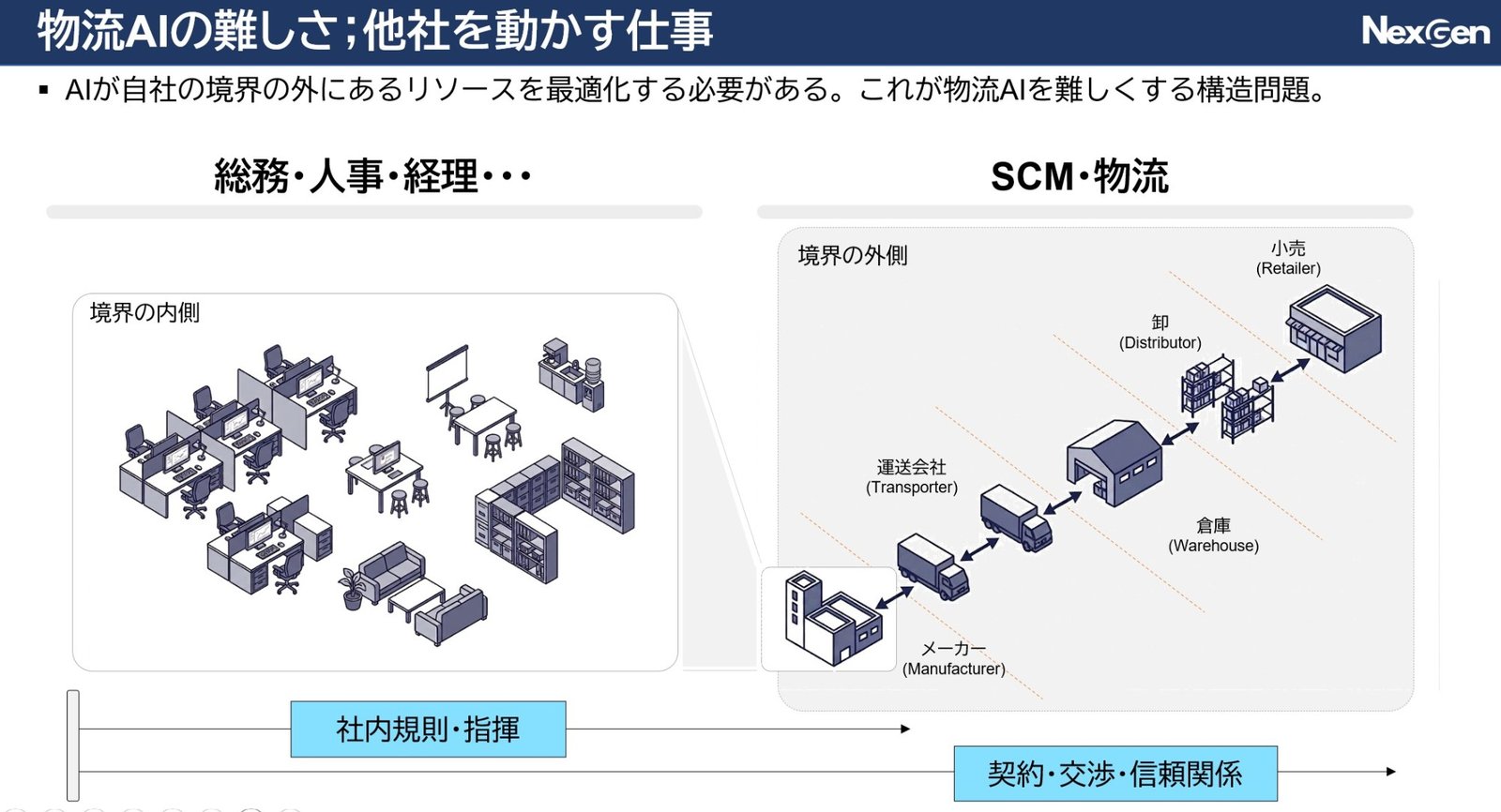
Figure 2: General affairs, HR and accounting work inside the boundary; SCM and logistics work outside it (from Nexgen Japan's presentation)
4. Closing
Logistics has always depended on people bridging the gaps between companies, and between operations and information. AI does not remove that work; it changes its order. Write down what experienced staff know, use it to run agents, hand the carved-out tasks to AI and leave the decisions to people.
Agents built this way settle in minutes what used to take days of phone calls and emails. Because they also put forward balanced options, they change the question in the meeting room from "Is sales or logistics right?" to "Given where the business stands, what price are we willing to pay?"
We thank X Mile Inc. for planning and running the conference, Yusuke Akazawa of LOGISTICS TODAY for the programme partnership and for moderating, and everyone who joined the final session on the final day.
5. References and key sources
- LOGISTICS TODAY, "「物流DX EXPO」開幕、物流改革の実装探る" (30 September 2026, in Japanese)
- LOGISTICS TODAY, "物流DX未来会議、改革の順番と伴走力を議論" (30 September 2026, in Japanese)
- LOGISTICS TODAY, "物流現場のDX化、AIを活用すればFAX排除は不要" (2 October 2026, in Japanese)
- Ariki Ono, "【寄稿】人材が不足する理由 サプライチェーンのAI求人は3年で387%増えた", LOGISTICS TODAY (28 September 2026, in Japanese)
- Marubeni Digital Innovation, "生成AI×OCRで複雑な受注業務を半自動化 従来不可能であった物流DXを最新技術で実現" (9 January 2026, in Japanese)
 Event report | LOGISTICS TODAY
物流現場のDX化、AIを活用すればFAX排除は不要
Event report | LOGISTICS TODAY
物流現場のDX化、AIを活用すればFAX排除は不要
Questions we often receive from practitioners
To use AI in logistics, do we first need to eliminate fax and standardise data formats?
No. It is quicker to get results by first building a process that reads incoming faxes with generative AI and turns them into data for shipping instructions. In order processing for a rice-cracker manufacturer, Marubeni Logistics switched to a method in which generative AI converts fax purchase orders into data in a set format and people only check and correct it, cutting order processing from a combined 17 hours a day to 9. The practical approach is to start with a workflow that keeps a human check, rather than waiting for 100% accuracy.
If AI agents negotiate with each other, can coordination between sales and logistics be automated?
What can be automated is narrowing down and laying out the options that satisfy the constraints. In the demonstration, the sales and logistics agents found 24 combinations that satisfied the constraints in a few rounds of exchange, then used a solver (an optimisation tool) to present three options with a good balance between stockout rate and logistics cost. Which one to choose depends on context that is not in the data, such as whether the company is building trust just after winning a new listing or protecting its margin, so people make the decision.
Consultation
Bring AI agents into coordination between sales and logistics
Our corporate seminar "The AI Frontier" introduces how generative AI works and the latest cases that practitioners need to know, and includes a workshop in which participants apply AI agents to their own company's operations.
Contact us →