
Key TakeawaysLogistics is no longer a cost centre; it is the only function inside a company that improves both ROIC (capital efficiency) and WACC (cost of capital).
Turning the supply chain into non-financial value need not be done all at once: focus via Pareto analysis on the priority areas that matter to management, and start by measuring CO2 with a single trusted partner — building that "data template" is the CLO's realistic first step.
From Nexgen's own perspective, this article examines three concrete points: "translating" SCM for the boardroom, the still-untapped white space of "management AI" beyond operational AI, and cross-functional governance with procurement, sales and legal.
Contents
- Event Overview
- Talk Summary: Turning Logistics into "Non-Financial Value"
- Nexgen View: Three Perspectives Connecting Management and the Supply Chain
- In Closing: 2026 Is Japan's Greatest Chance to Change
- References & Primary Sources
1. Event Overview
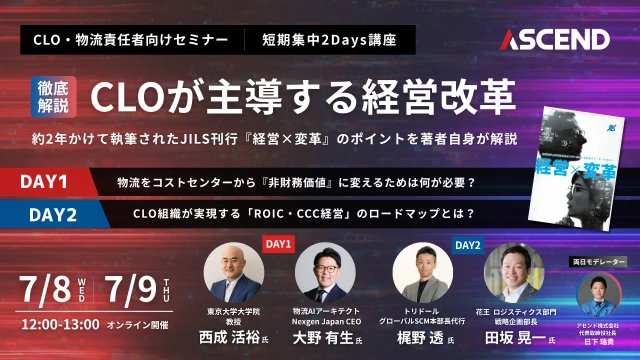
On 8 July 2026, our CEO and Logistics AI Architect Ariki Ono was featured in Part 1 of Ascend Inc.'s webinar "CLO-Led Management Reform: An Intensive 2-Day Course."
The seminar is a two-part course that uses the booklet "Management × Transformation," published by the Japan Institute of Logistics Systems (JILS) as its set text, examining from a management perspective the CLO (Chief Logistics Officer), whose appointment became mandatory in April 2026. Our CEO, Ariki Ono, authored Chapter 1 of that set text.
The opening remarks were given by Professor Katsuhiro Nishinari of the University of Tokyo Graduate School, who led much of the booklet's discussion, and the moderator was Mizuki Kusaka, Representative Director of Ascend Inc. Part 2 featured Toru Kajino of Toridoll Holdings and Koichi Tasaka of Kao — a structure that ran from theory through to real-world examples across the two days.
Below, we report the key points of the talk and then, now that the seminar is over, share where Nexgen Japan's thinking is heading.
2. Talk Summary: Turning Logistics into "Non-Financial Value"
The theme of Part 1 was "What does it take to turn logistics from a cost centre into 'non-financial value'?" Nexgen Japan conveyed three main points.
The three points we conveyed on the day
Logistics: from "cost" to "management matter"
Logistics is no longer back-office cost that supports production; it has become a management matter that determines corporate value. With supply constraints from a shrinking population, rising e-commerce demand, and the 2017 last-mile delivery crisis as a turning point, logistics now ties directly to revenue and profit, and national policy positions supply-chain resilience, pursued through DX, decarbonisation and economic security, as a priority.
The only function that improves both ROIC and WACC
Only the supply chain can raise ROIC (capital efficiency) through cost reduction and inventory compression while improving ESG ratings via BCP, human-rights due diligence and Scope 3 disclosure, thereby lowering the cost of procurement finance (WACC). Schneider Electric cut CO2 by 56% with 1,000 upstream suppliers, reached 98% human-rights due-diligence compliance, and ranked first worldwide for four consecutive years in Gartner's "Global Supply Chain Top 25," where 20% of the score is ESG. Non-financial value is already built into the yardstick.
And even so, "you don't have to do everything"
Advancing with every supplier at once demands company-wide data preparation on the scale of billions of yen, and the effort stalls before it begins. Use Pareto analysis to focus on the priority areas that matter to management, partner first with a single supplier you already trust, and measure CO2 together. Rolling out the resulting "data template" from the highest-priority areas downward is the CLO's realistic first step.
3. Nexgen View: Three Perspectives Connecting Management and the Supply Chain
From here, we connect the day's discussion to our own earlier work and add further reflection from three angles: management, AI and practice.
3-1. The Management View: "Translating" SCM for the Boardroom
One thing we said frankly at the seminar was that "for management, SCM on its own is not, as it stands, a management issue." Having finished the talk, we feel anew that this was the very heart of the seminar.
What executives usually watch through are three lenses: the macro environment and resilience in a crisis, demands from capital markets and regulators, and competitive position and corporate value. SCM becomes an item on the management agenda only when it is tied to those lenses; the rest of the time it drops out of view. That is the reality. This is precisely why the first job asked of a CLO or a logistics function is not a sophisticated optimisation algorithm but "translation." Take the explanation "we'll introduce robots at this site, and here's the cost-benefit," and reframe it into the language of management: "this is a hedge against structural labour shortages, it will be reflected in the sustainability report, and it is an investment that improves our downstream access to finance."
The activity itself is the same, but simply working back from the business goal and retelling it along the view executives are watching transforms how it lands with the board.
3-2. The AI View: Operational AI and Management AI — the White Space Still Unfilled
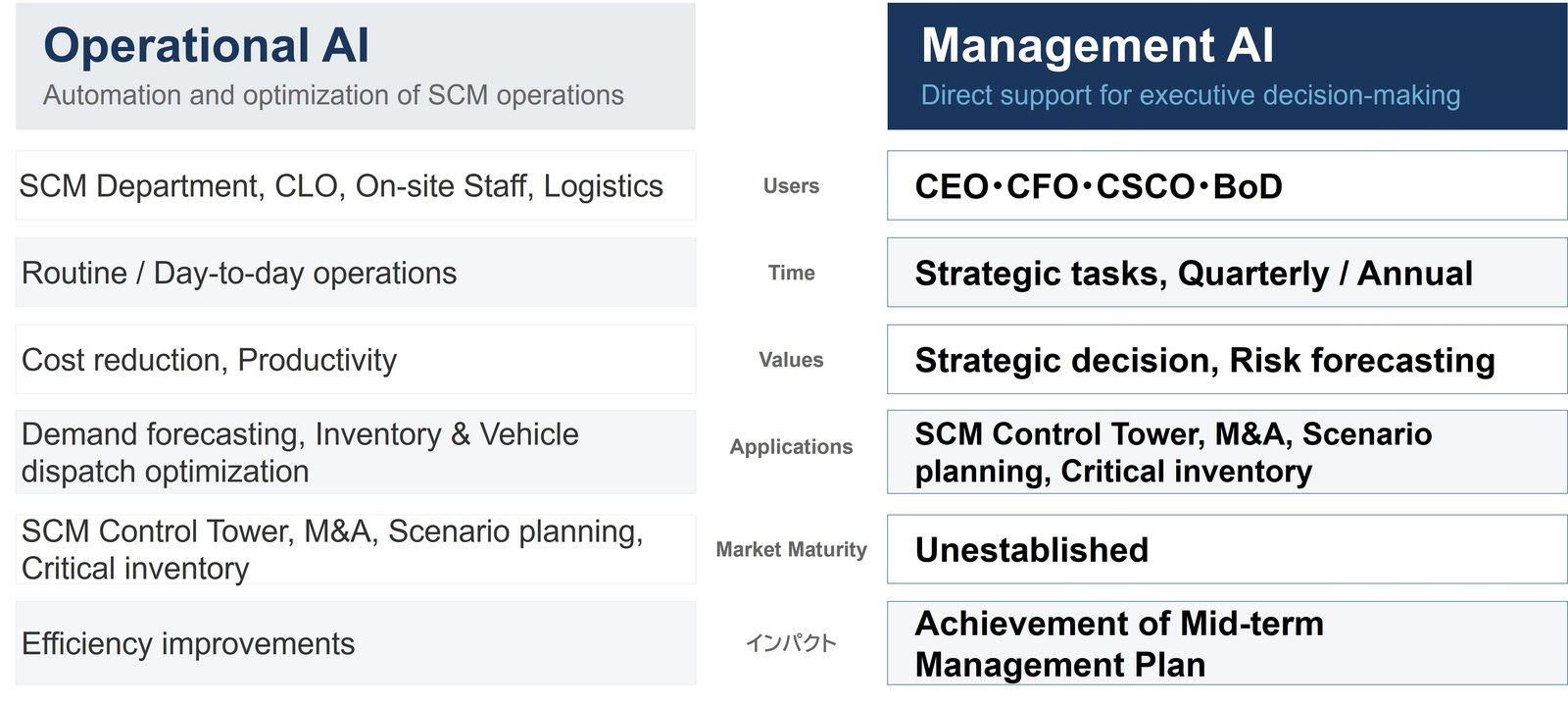
Let us expand a little on the point we placed at the end of the seminar deck. The great majority of solutions called "AI × SCM" are "operational AI" that make the front line's routine work — demand forecasting, inventory optimisation, dispatch planning — more efficient. This area is already crowded with competitors and is becoming a mature market where rivals compete over single-percentage-point improvements.
What executives really want, we believe, is "management AI" that supports the very decisions of the CEO, CFO and board: an SCM control tower, scenario analysis for M&A and crises, management judgement on critical inventory. And solutions in this area remain, worldwide, almost entirely undeveloped. The impact is not efficiency gains measured in percentage points but the achievement of the medium-term management plan — that is, corporate value itself.
Now that the mandatory appointment of CLOs has created demand for "people who can speak of the supply chain in the language of management," this white space is exactly the theme Nexgen Japan will tackle from three directions: research, consulting and product.
3-3. The Practical View: Hold Cross-Functional Governance with Procurement, Sales and Legal
Finally, if we name a single starting point for practice from tomorrow, it is to hold a standing forum with three functions — procurement, sales and legal. Logistics problems cannot be solved by logistics alone. Procurement is the gateway to collaboration with suppliers, sales is the link for sharing information with customers and the sales force, and legal is the point where regulatory response can be turned into either risk or opportunity.
You need not start with all three at once; even one lateral, cross-functional connection changes the "power of words" you carry to management.
4. In Closing: 2026 Is Japan's Greatest Chance to Change
At the seminar's close, Nexgen Japan left this message.
Closing message
Among your ten budgeted projects, try folding in even one element from today into each. Now, in 2026, is the only time you can do this. I believe it is Japan's greatest chance to change.
The revised Logistics Efficiency Act and the mandatory appointment of CLOs are not a goal but a starting line. The law is a means; the CLO's duty comes down to raising corporate value. To spread this understanding across the boundaries of shippers, logistics operators and government, Nexgen Japan will continue its research, its communication and its implementation work.
Finally, we extend our thanks to Ascend Inc. for planning and hosting the seminar, and to Professor Nishinari, Mr Kajino, Mr Tasaka and Mr Kusaka for the invaluable insights they shared.
5. References & Primary Sources
- Ascend Inc., "A Thorough Guide: CLO-Led Management Reform — An Intensive 2-Day Course" (event overview / press release)
- Japan Institute of Logistics Systems (JILS), "Management × Transformation" (the seminar's set text; Nexgen Japan authored Chapter 1)
- Supply Chain Management Review, "Schneider Electric again tops Gartner's Top 25 Supply Chain rankings" (Schneider Electric retains the top spot in Gartner's "Global Supply Chain Top 25"; ESG is part of the yardstick)
 Event Overview — Ascend Inc.
A Thorough Guide: CLO-Led Management Reform — An Intensive 2-Day Course
Event Overview — Ascend Inc.
A Thorough Guide: CLO-Led Management Reform — An Intensive 2-Day Course
Related Seminar
The Generative AI Frontier — For Leaders Who Drive Change
To "translate" logistics and the supply chain into the language of management and step into the white space of management AI. We systematise the latest global trends, industry cases, and the knack of implementation for leaders who drive change.
View seminar details →