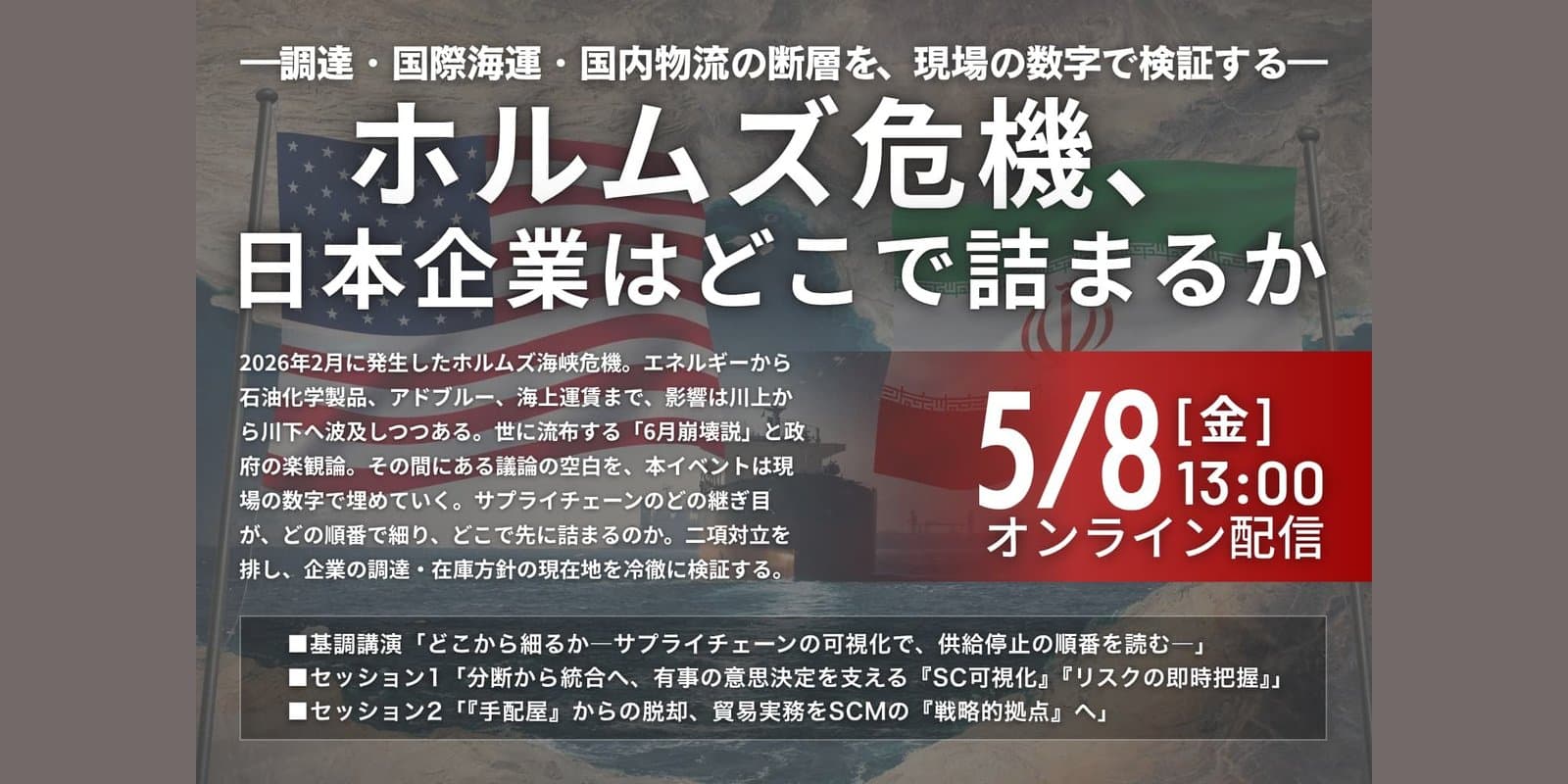
Key TakeawaysOn 8 May 2026, Nexgen Japan participated in the LOGISTICS TODAY emergency event "Where Will Japanese Companies Get Stuck in the Hormuz Crisis?" — joining six experts to take stock seventy days into the crisis
In an era of international logistics where "crisis is the new normal," we set out the next actions: an impact-emergence simulation, multi-tier visibility for critical items, and coordination across management, legal, logistics, and procurement
We examine the common structure that emerged across the late-March Nexgen Expert View "Hormuz Expert View," the JILS "Management × Transformation" white paper of April, and this special event
Table of Contents
- Event Overview
- What Nexgen Japan Argued
- Key Points from Other Speakers
- Nexgen Lens — The Organisational Picture of "Crisis Is the New Normal" Across the Trilogy
On 8 May 2026, Nexgen Japan CEO and Logistics AI Architect Ariki Ono delivered the keynote at the emergency event "Where Will Japanese Companies Get Stuck in the Hormuz Crisis?", hosted by LOGISTICS TODAY. This article recaps the session and, drawing in the late-March Expert View "The Iran Conflict and Hormuz Crisis: Supply Chain Resilience Strategies for Japanese Businesses" together with the JILS white paper "Management × Transformation" published in April, draws the perspectives of this trilogy together as a Nexgen Lens.
1. Event Overview
The event was held on 8 May, seventy days after the Strait of Hormuz crisis began on 28 February 2026. By that point, physical disruption to logistics networks had transformed into serious materials shortages, and the shock had begun to ripple through the real economy as a whole — making this an emergency stocktake at exactly that inflection point.
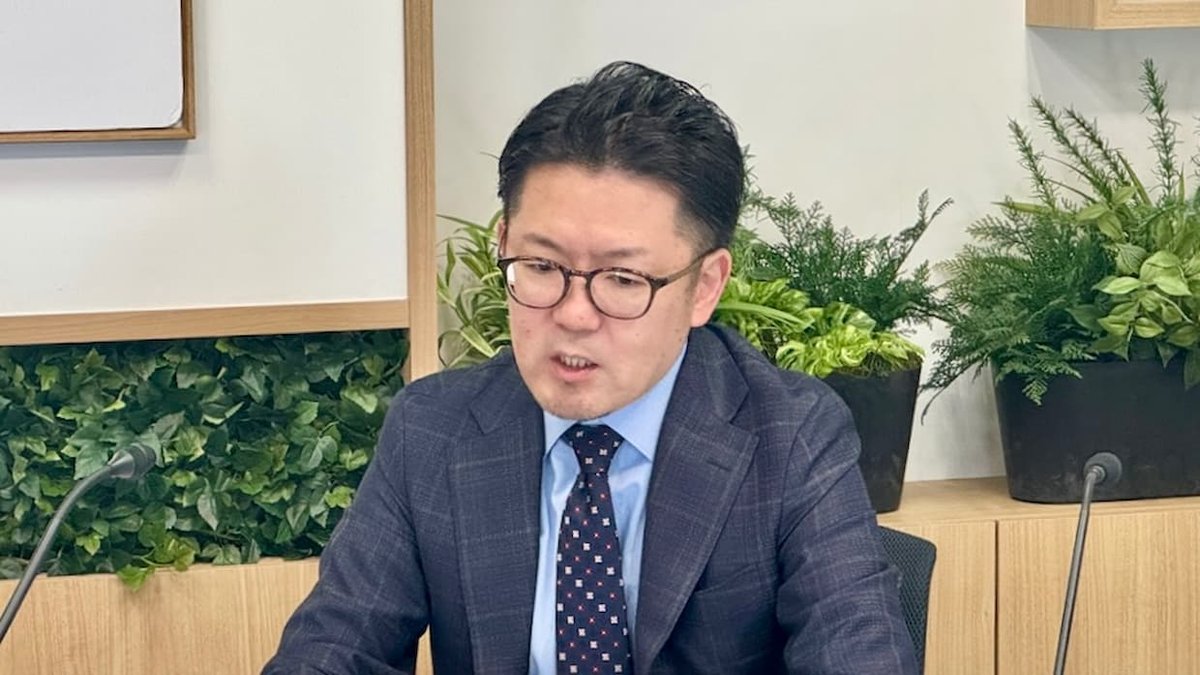
▲ Nexgen Japan CEO and Logistics AI Architect Ariki Ono (Source: LOGISTICS TODAY)
The six speakers, alongside moderator Yusuke Akazawa (Editor-in-Chief, LOGISTICS TODAY), were as follows.
| Speaker | Affiliation / Position |
|---|---|
| Ariki Ono | Nexgen Japan CEO & Logistics AI Architect / Principal, Tokio Marine Holdings |
| Masashi Onozuka | Partner, Roland Berger |
| Etsuji Kimura | Deputy General Manager, Sojitz Tech-Innovation |
| Fumiyuki Ota | President & CEO, Zenport |
| Kenjiro Murakami | CEO, Spectee |
| Akiyoshi Kawashima | Evangelist, Shippio |
2. What Nexgen Japan Argued
Seventy days into the crisis, Nexgen Japan presented a structured view of when, what, and how companies should prepare. The argument was organised around four points.
2-1. The Shockwave Surfaces Weeks Later — A Four-Tier Propagation Structure
A crisis does not strike management instantaneously. Starting from disruption at sea and at ports, the impact then descends through materials and intermediates → components → finished goods and the market — a four-tier cascade with delays of several weeks to several months.
| Elapsed Time | Affected Tier | What Is Happening |
|---|---|---|
| Day 0–25 | Sea / Ports (Logistics) | Strait-transit constraints and carrier avoidance; spinning up alternative ports and land bridges |
| Day 25–60 | Materials / Intermediates | Delayed supply of resin, aluminium, and rubber feedstocks |
| Day 35–60 | Components (Manufacturing Impact) | Tier 3 processing-aid shortages → Tier 2 part shortages → production adjustments at Tier 1 |
| Day 60+ | Finished Goods / Market | Changes to assembly plans for finished goods; ripple effects on spare parts and the sales front line |
What begins as a "logistics crisis" transforms into a "materials problem" within one to one-and-a-half months as critical inputs run dry. By two months, the impact reaches Tier 1 component "production lines"; by three months, the impact spreads into everyday life. Right now, we sit precisely on that boundary.
2-2. The X-Day of Impact Emergence
"When will it surface?" is not a matter of luck — estimating it is essential. The impact-emergence date can be computed from four variables.
T = Crisis-onset date + (LT + H + Q) − IC
- LT: Transport Lead Time
- H: Additional delays from port congestion and vessel-space shortages (Hold/Handling)
- Q: Qualification period for alternative suppliers
- IC: Inventory Coverage in days
Plugging in typical values for the automotive industry
T = 28 Feb + (LT 55 + H 25 + Q 70) − IC 50 = 28 Feb + 100 days = 8 June
In other words, this is a concrete forecast that inventories in the automotive industry will start to bottom out around 8 June, one month from now. It is not a vague anxiety; it is a countdown explainable through four variables.
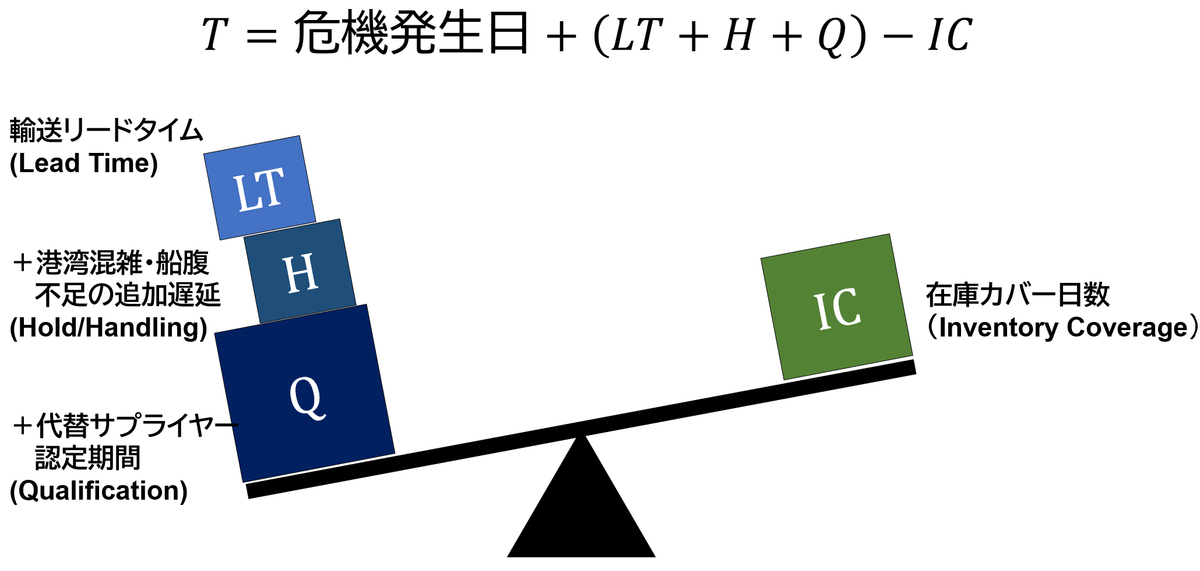
Figure 1. Estimated date of impact emergence (T) — A seesaw diagram balancing transport lead time (LT), port congestion and vessel-space delays (H), and supplier-qualification period (Q) against inventory coverage (IC). Labels in Japanese.
2-3. The Inventory Paradox — Company-Wide Stock Hides "True Fragility"
Yet how IC (inventory coverage) is read is the most widely misunderstood piece of the X-Day equation.
Industry-average company-wide inventory days look reassuring at a glance — food at 10–40 days, automotive at 20–60, housing at 60–120, apparel at 80–120, chemicals at 100. "Tens to a hundred days of buffer." However —
Even with 100 days of company-wide stock, if an irreplaceable specific resin has only 10 days, operations stop the moment that resin runs out.
This is the "inventory paradox." The true breaking point lies in the thin lot-level inventory of "irreplaceable critical materials" — multi-grade items with tight qualification constraints. What matters is not the total value but how many days of cover the critical items have.
There are three layers of critical items.
| Layer | Who Decides | Examples | Position |
|---|---|---|---|
| ① Strategic Materials of Social / Policy Importance | Government, industry bodies | Crude oil, LNG, fertiliser, semiconductors, pharmaceuticals, critical minerals | National / industrial level |
| ② Industry-Wide Critical Items | Visible from industry structure | Automotive: semiconductors, resins, aluminium; food: packaging and additives; chemicals: naphtha | Likely choke points industry-wide |
| ③ Company-Specific Critical Items | Set by each company itself | Specific resins, specific suppliers' additives, dedicated tooling components | Directly halts actual operations |
Releases from national stockpiles work at layer ①. But what actually halts operations is layer ③. The starting point of crisis response is "multi-tier inventory visibility" — combining BOM data, inventory coverage, alternative-supplier qualification status, and transport-corridor dependency to surface a company's own critical items at the lot level.
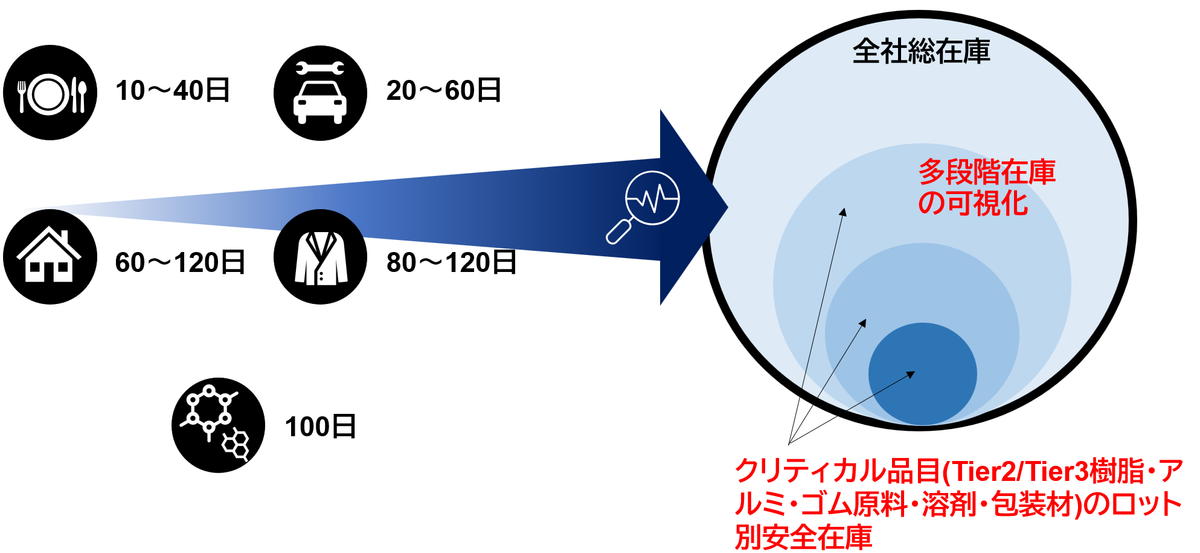
Figure 2. Company-wide stock hides "true fragility" — Industry-average inventory days (food, automotive, housing, apparel, chemicals) look reassuring, but the lot-level safety stock of critical Tier 2/Tier 3 inputs is what actually constrains operations. Labels in Japanese.
2-4. The Cone of Uncertainty and Four-Function Coordination — Logistics Alone Cannot Stop the Bleeding
Given this structure, it becomes clear that crisis response is no longer a problem for the logistics function alone.
Suez, the Red Sea, Hormuz — chokepoint crises are bound to recur, "shifting location each time." We have entered an era where management must build in the thinking of the cone of uncertainty (Schoemaker, Day & Snyder, 2013): "do not bet on a single future; survey a wide possibility space of futures."
For the future of the Hormuz crisis itself, we set out three scenarios.
| Scenario | Content |
|---|---|
| Upside: Early partial reopening | The IMO maritime corridor functions. Insurance premiums, fuel costs, and charter rates do not return to peacetime levels immediately, however; surcharges linger for some time |
| Base: High costs become the norm | Transit only partially returns and high costs persist. Oxford Economics expects uncertainty to continue at least through 2026; the BoJ projects CPI in the upper-2% range and downside risk to growth |
| Downside: Prolonged closure and a manifest supply constraint | Transit fails to function in practice for an extended period, exceeding the time bought by stockpile releases. Companies that have not decided in advance "what to halt and what to keep moving" experience simultaneous "panic buying at high prices" and production cuts |
We argued that in any of these scenarios, four-function coordination across management, legal, logistics, and procurement is essential.
| Function | What Must Be Prepared in Peacetime |
|---|---|
| Management | Setting threshold inventory-coverage days for critical items; pre-defining the cost envelope and the decision-maker once that threshold is breached |
| Legal | Examining the applicability of force majeure clauses; verifying war-risk insurance terms (additional premiums, exclusions, etc.) |
| Logistics | Visibility into inbound ETA volatility and unconfirmed bookings; standardising rules for surcharge pass-through |
| Procurement | Securing spot capacity at alternative suppliers; reserving cash-out envelopes for accelerated payments |
Just-in-Time (JIT) efficiency was the optimum in peacetime. But in an era where "crisis is the new normal," what is needed is a shift to Just-in-Case (JIC) — emphasising redundancy and preparedness. And JIC cannot be implemented by the logistics function alone.
3. Key Points from Other Speakers
The other five speakers also brought important arguments grounded in front-line numbers and operational expertise. Drawing on the LOGISTICS TODAY article "The Hormuz Crisis Pushes Supply Chains to the Limit; Manufacturing Risk Becomes Reality," we summarise the key points.
Masashi Onozuka (Partner, Roland Berger) — Five Risk Categories and Elevation as a Management Issue
Mr Onozuka pointed to the petrochemical industry as taking the heaviest hit, given that 95% of crude-oil imports and 40% of naphtha pass through the Strait of Hormuz. Maritime shipping is being rerouted around the Cape of Good Hope, with lead times extending by roughly 10–14 days.
Building on this, he classified the risks companies must address into five categories — economic, environmental, geopolitical, social, and technological. Rather than delegating these to a particular function, he argued that the cycle of "risk assessment (visualisation), response, and monitoring" must be run as a management agenda.
Etsuji Kimura (Deputy General Manager, Sojitz Tech-Innovation) — Trade Operations as a "Strategic Hub"
Mr Kimura noted that 70% of trade-operations practitioners are over 40 years old, with the work sustained by individual experience and intuition. Because operations have not been standardised and remain a black box, when a key person is absent, risks such as overstay charges at port surface immediately.
He recommended "asset-ifying" data through a "small-start" approach — beginning digitalisation from a specific task — and argued that trade operations must shift from a "booking desk" into a "strategic hub" that shapes SCM-wide judgement.
Fumiyuki Ota (CEO, Zenport) / Kenjiro Murakami (CEO, Spectee) — How to Implement Visibility
Mr Ota pointed to the need to transform supply chains from a linear structure into a multi-polar, mesh-like structure.
Mr Murakami emphasised the importance of using generative AI to analyse risk information from social media and sensor data in real time, bringing visibility deep into the supplier base.
Akiyoshi Kawashima (Evangelist, Shippio) — The Triple Constraint and the Indispensability of the CSCO
Mr Kawashima asserted that political ceasefire and the normalisation of shipping will not happen simultaneously. Beyond the lifting of physical blockades, a triple constraint of "sanctions risk," "financial cut-off," and "tightening of insurance" is the binding shackle on shipping. Until shipowners, operators, and captains all judge transit "100% safe," commercial navigation will not resume.
On that basis, he argued that a CSCO (Chief Supply Chain Officer) is indispensable to underwriting stable supply. Through platforms, delays and stockout risks must be detected early, and a structure built that aggregates and shares first-hand information with the C-suite in real time.
4. Nexgen Lens — The Organisational Picture of "Crisis Is the New Normal" Across the Trilogy
From here, we read this event not as a stand-alone occurrence but within the sequence of analyses Nexgen Japan has been publishing since the end of March.
The timeline:
| Date | Nexgen Publication | Position |
|---|---|---|
| 31 Mar 2026 | Expert View: "The Iran Conflict and Hormuz Crisis: Supply Chain Resilience Strategies for Japanese Businesses" | One month into the crisis: simultaneous propagation across four routes, three scenarios, and the need for cross-functional organisation |
| 23 Apr 2026 | Chronicle: "Authoring Chapter 1 of JILS 'Management × Transformation' White Paper" | Sets out the worldview of "crisis is the new normal" and the three responsibilities of the CLO |
| 8 May 2026 | This special event (Chronicle) | Seventy days in: where the insights of six experts intersect with our argument |
4-1. Verifying the Late-March Forecasts
Seventy days on, the late-March Expert View was borne out as follows.
Points that aligned
- Simultaneous "physical disruption" and "economic disruption" — Mr Kawashima's point about the triple constraint (sanctions, finance, insurance) is precisely the late-March argument made real: "even if the strait is physically open, ships won't move unless the economic conditions are in place."
- The importance of "organisational design that transfers to the next crisis" — Mr Ota's mesh structure, Mr Murakami's generative-AI visibility, and Mr Kimura's strategic-hub thesis were all argued not as "Hormuz countermeasures" but as "organisational capability usable across any crisis."
Points updated as the situation evolved
- What was discussed abstractly in late March as "the timing at which inventories will run dry" has now reached the stage where it can be calculated as a concrete date — 8 June — using the T-formula. This converts "vague anxiety" into a "countdown-style management agenda."
4-2. "Crisis Is the New Normal" Was Validated on the Ground
The worldview Nexgen Japan put forward on 23 April — "crisis is the new normal" — was confirmed at this special event as an operational reality.
What was symbolic was that all six speakers spoke on the premise of a "next crisis." Not one of them said "if Hormuz settles down, things will return to normal." Suez, the Red Sea, Hormuz, Trump tariffs, extreme weather, port strikes, bridge collapses — the events listed in JILS Chapter 1 are no longer "unforeseeable emergencies" but everyday reality, and that recognition was shared by everyone in the room.
In other words, the "crisis is the new normal" worldview is no longer just Nexgen's argument; it is becoming the shared baseline of the supply-chain expert community.
4-3. From CLO to CSCO — The Cross-Functional Organisation Enters the Operating Phase
Nexgen Japan put forward three responsibilities for the CLO.
- Become the "control tower" for the entire global supply chain
- Monitor global developments and recommend resilient sourcing shifts
- Build a system that continuously recalibrates inventory thresholds in response to lead-time volatility
The "CSCO" that Mr Kawashima set out at this event maps onto these completely. Drawing first-hand information from a platform and aggregating strategic intelligence to support the CEO's judgement — this is precisely the operating form of what Nexgen Japan has argued for: "a reporting line directly under the CEO, with the authority to cut horizontally across all functions."
And the four-function coordination requirement across management, legal, logistics, and procurement is the operating blueprint for that cross-functional cut, which the CSCO/CLO carries.
| Dimension | JILS "Management × Transformation" | This Event (May) |
|---|---|---|
| The role | Three responsibilities of the CLO | Mr Kawashima: indispensability of the CSCO |
| Organisational design | Cross-functional organisation under the CEO | Ono: four-function coordination across management, legal, logistics, procurement |
| Information design | Real-time aggregation of first-hand information | Mr Kawashima: strategic intelligence delivered via platforms |
The late-March argument for "the necessity of organisational design" advanced through April's "theory of the role (CLO)" and arrived in May at "concrete four-function coordination requirements and an operating form (CSCO)." Over three months, the resolution of the discussion has stepped up notch by notch. What you see across the trilogy is precisely this evolution.
A Word from Nexgen Japan
In a world where "crisis is the new normal," crisis response is not an accident; it is operations.
If it is operations, then it is something that can be designed, run, and improved. Nexgen Japan provides hands-on support for supply-chain transformation, taking the following as starting points:
- Multi-tier inventory visibility (lot-level grasp of critical items)
- X-Day calculation of impact emergence (countdown management based on the T-formula)
- Standing up the CSCO/CLO function and designing four-function coordination
Not "Hormuz countermeasures," but — without waiting for the next crisis — what to start in peacetime. We welcome enquiries on "where to begin."
Related Links
Event Coverage
LOGISTICS TODAY article on the day, "The Hormuz Crisis Pushes Supply Chains to the Limit; Manufacturing Risk Becomes Reality" (published 8 May 2026): https://www.logi-today.com/948383
Speakers' Affiliated Companies and Hosting Media
- LOGISTICS TODAY https://www.logi-today.com/
- Tokio Marine Holdings https://www.tokiomarinehd.com/
- Roland Berger https://www.rolandberger.com/ja/
- Sojitz Tech-Innovation https://www.sojitz-ti.com/
- Zenport https://zenport.io/
- Spectee https://spectee.co.jp/
- Shippio https://www.shippio.io/