
Key TakeawaysDrawing on the "Logistics × AI Adoption Survey 2026" (233 valid responses), the panel discussed the reality on the ground and the first step towards implementation
Rather than demanding 100 points from AI, the speakers set out an implementation that starts small — AI proposes candidates at 60–80 points and humans make the final call
Here we add to the discussion Nexgen Japan's further analysis from the standpoints of logistics (SCM) and generative- and physical-AI implementation, drawn together as a Nexgen View
Table of Contents
- Event Overview
- A Front Line Where Expectation Runs Ahead
- The Speakers' Arguments — Running on 60–80 Points
- What Nexgen Japan Argued — Risk and Governance
- Nexgen View — A Further Reading from Logistics and Physical AI
- References & Primary Sources
On 29 June 2026, Nexgen Japan CEO and Logistics AI Architect Ariki Ono spoke at the online event "LOGISTICS AI AWAKENING 2026 — AI-Driven Practice Summit [Act I] Fundamentals & Implementation," hosted by LOGISTICS TODAY. The proceedings were also reported in the host's own article, "Logistics AI: Charting the Right Path to Implementation for an Expectant Front Line."
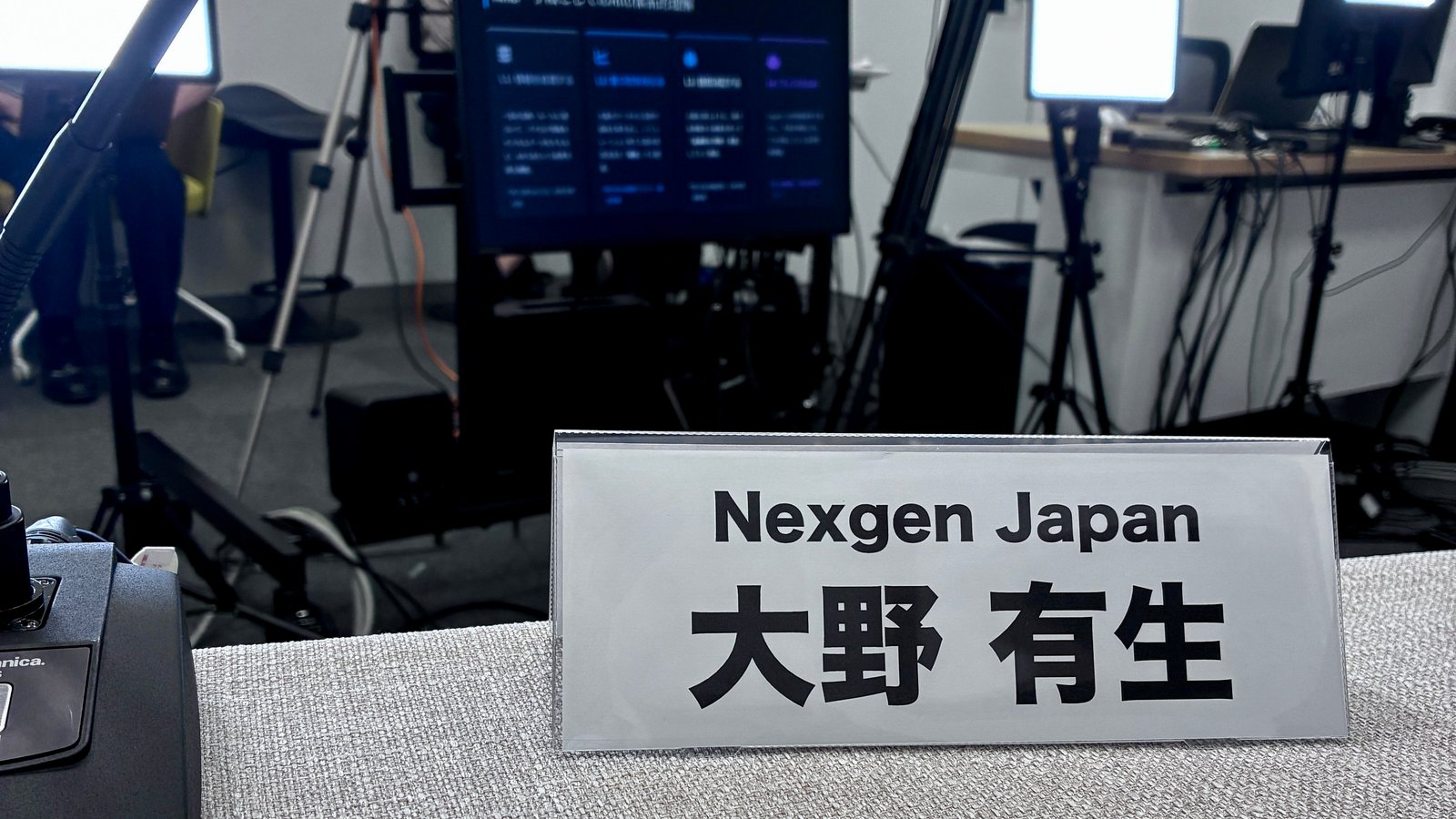
▲ The LOGISTICS AI AWAKENING 2026 recording set — the speaking position of Nexgen Japan CEO and Logistics AI Architect Ariki Ono (Source: Nexgen Japan)
1. Event Overview
This was the main session, following a pre-event on 28 May. It set out to organise the current state of logistics AI and the fundamental points of implementation. The three speakers were as follows, with the LOGISTICS TODAY editorial team moderating.
| Speaker | Affiliation / Position |
|---|---|
| Kensuke Kijiya | Executive Officer, Hacobu / Head of Hacobu Solution Studio (logistics data infrastructure "MOVO") |
| Kazuhiro Okazawa | President & CEO, KURANDO (in-warehouse work visualisation "Logimeter") |
| Ariki Ono | CEO & Logistics AI Architect, Nexgen Japan |
The first half read the reality out of the "Logistics × AI Adoption Survey 2026" (233 valid responses); the second half moved on to the order of implementation.
2. A Front Line Where Expectation Runs Ahead
Respondents spanned shippers and logistics operators from SMEs to large enterprises, and from the C-suite to front-line staff — a sign that interest is not confined to IT and DX functions. Yet on the ground, expectation runs ahead of reality. Four structural issues surfaced.
Four Walls the Survey Brought to Light
Uneven Digitalisation
While WMS adoption has advanced for in-warehouse receiving, shipping, and inventory management, slips and waybills, daily reports, roll-calls and attendance, and vehicle dispatch and delivery planning still depend on paper, Excel, email, and manual entry. Work at external touchpoints spanning shippers, carriers, and trading partners is especially hard to digitalise on one's own.
Data That Is "Collected but Unusable"
"We ought to be getting more out of it" was the most common response. The bottleneck is not a lack of data but the step of processing and analysing it to feed decisions.
The Standout: "Reliance on Individuals"
The issue most wanted solved was, by a clear margin, "reliance on individuals." Work that leans on veterans' tacit knowledge — dispatch, transport arrangement, load planning — is the main battleground for AI, yet the more person-dependent the work, the harder it is.
A Gap Between Interest and Investment
The top barriers were "hard to see the effect," "no people who can use it," and "tool selection is difficult." On budgets, too, "under consideration but not yet funded" was common — interest is not translating directly into investment.
3. The Speakers' Arguments — Running on 60–80 Points
LOGISTICS TODAY organised AI use into four levels: L1 for turning things into data, L2 for decision support, L3 for autonomous decision-making, and L4 for physical AI. The main battleground — and the first step — is L1 and L2.
Mr Kijiya (Hacobu) — Generative AI-OCR as the "Entry Point"
He introduced AI-OCR as an example in the transport domain. Handwriting, marginal notes, and formats that differ by trading partner are hard for conventional OCR, which pre-defines field positions, to handle. Generative AI can interpret the meaning of a document and turn it into data, making it an entry point to efficiency gains.
Mr Okazawa (KURANDO) — Getting the "People" Data in Order
In warehouses, inventory and shipping data are accumulating, yet "people" data — staffing, work progress, and per-worker performance — remains the challenge. He argued that the prerequisite is a design for what granularity of front-line information to gather and which judgements to feed it into.
The Shared Outlook — "You Cannot Leap Straight to Full Automation"
All three shared the view that AI should not be pushed straight to full automation. The front line is full of exception conditions and lines of responsibility, so demanding 100-point automated judgement invites failure. The realistic answer is a form in which AI presents candidates at 60–80 points and humans make the final call. For dispatch, staffing, and invoice reconciliation alike, AI handles first-pass processing or the extraction of anomaly candidates, and human review builds on top. Rather than driving "data → use → automation" in a straight line, the key is to run many small cycles that each begin at 60–80 points.
4. What Nexgen Japan Argued — Risk and Governance
Beyond implementation, Ono also spoke to risk and governance. Generative AI carries the risks of hallucination (producing errors that look plausible), confidential-data leakage, and copyright infringement — and in logistics the first two matter most. His proposed countermeasure was the separation of "AI usage rules" from "AI management rules."
Set Up the Two Rulebooks Separately
AI Usage Rules (for those who use it)
A code of conduct the front line follows: the scope of information that may be entered, the environment of use, how outputs are handled, and so on.
AI Management Rules (for those who oversee it)
The mechanism by which the organisation operates and supervises: what to do when accuracy degrades, which function is accountable, retraining, data retention, and the like.
Implementation requires not only introducing the technology but an operating design that builds in explainability, human review, and governance — that was the central message.
5. Nexgen View — A Further Reading from Logistics and Physical AI
From here, we connect the day's discussion to what Nexgen Japan has been publishing, adding further analysis from two standpoints: logistics (SCM) and generative- and physical-AI implementation.
5-1. The Logistics View: "Reliance on Individuals" Is a Problem of Data — and, at Once, of Organisational Design
"Reliance on individuals" is often framed as a technical challenge: how to turn tacit knowledge into data. In the practical domain of logistics, however, there is a deeper problem.
Dispatch, transport arrangement, and load planning all involve constraints that intertwine across the boundaries of organisations — shippers, carriers, and trading partners. AI-enabling logistics processes is hard precisely because these constraint conditions and partner-specific rules have not been turned into data.
This is exactly why examining the work through the four lenses of "management, operations, technology, and organisation" pays off. Dissolving reliance on individuals is not completed by technology (introducing OCR or tools) alone. Only with a redesign of the workflow — deciding which judgement in which task to entrust to AI and where humans retain control — and a cross-organisational agreement that aligns operations spanning companies, does data connect to decisions. The true nature of "we have data but cannot use it" is often this missing design.
5-2. The Implementation View — Running at 60–80 Points Is PoV, Not PoT
What matters in the arguments "do not demand 100 points from AI" and "propose candidates at 60–80 points plus human final judgement" is that the purpose of running small at 60–80 points lies not in verifying technical accuracy (PoT: Proof of Technology) but in verifying value (PoV: Proof of Value). The question is not "what recognition accuracy did it hit?" but "even at that accuracy, does combining it with people create value for the work?" This very shift of mindset is the key to landing an expectant front line on real implementation.
5-3. The Physical-AI View — Today's L1/L2 "Operational Data" Becomes Tomorrow's L4 Asset
The L1–L4 framing LOGISTICS TODAY presented is rich in implication. This time the main battleground was L1 (turning things into data) and L2 (decision support), but advancing these two steadily is also a stepping stone to the future L4 (physical AI).
Physical AI has one decisive property: it "cannot be rolled back." Unlike software AI, once it breaks something or injures someone on the front line, there is no undo. And even when an era arrives in which humanoids are mass-produced and cheap, running them in your own operations demands, as we argued at the Logistics & SCM Transformation Tech EXPO (LGX 2026), your own operational data.
In other words, the "turning paper into data," "putting person-dependent judgement into words," and "accumulating work records" discussed here are not mere efficiency gains. They are the work of building up operational data as an asset — the very asset needed to bring humanoids onto your own front line in the physical-AI era. Rather than going head-to-head with the US and China in the development race, describe your own operations at high resolution and accumulate the data. How the next two years are spent will decide the winning path in the physical-AI era. This event's conclusion — start from L1 and L2 — takes on its full meaning only in this long-term context.
6. References & Primary Sources
- LOGISTICS TODAY, "A Crisis for the Paper-Gut-Grit Front Line: Strike Back Against the Logistics AI Divide" (22 May 2026 / related pre-event)
- Hacobu (logistics data infrastructure "MOVO")
- KURANDO (in-warehouse work visualisation "Logimeter")
- Gartner, "Gartner Says There is an Outsized Need for AI Talent in Supply Chain" (June 2026 / demand for AI talent in supply chain)
- Gartner, "Gartner Predicts 60% of Supply Chain Disruptions Will Be Resolved Without Human Intervention by 2031" (March 2026)
 Original Coverage — LOGISTICS TODAY
Logistics AI: Charting the Right Path to Implementation for an Expectant Front Line
Original Coverage — LOGISTICS TODAY
Logistics AI: Charting the Right Path to Implementation for an Expectant Front Line
Related Seminar
The Generative AI Frontier — For Leaders Who Drive Change
From the essence of "do not demand 100 points from AI," through setting up AI usage rules and AI management rules, to designing for PoV. We systematise the latest global trends, industry cases, and the knack of implementation for leaders.
View seminar details →