An article authored by Ariki Ono, CEO of Nexgen Japan, was published on 23 June 2026 by the World Economic Forum (WEF). Titled "What Is the Future of Work? Defining Roles for Humans and AI," it presents, on an international stage, the value that remains human precisely as AI takes on more of the work. The piece was published as part of the Agenda for the Annual Meeting of the New Champions 2026.
Key Takeaways
- As AI grows more capable of producing content, analysis, and recommendations, human value shifts towards defining the problem, framing the constraints, reading the results critically, and making the final call
- Two new roles emerge for working with AI: the "AI Architect", who designs how AI is used in the real world, and the "AI Steward", who confronts AI's outputs and their consequences in the real world
- Organisations adopting AI must fundamentally redesign work and training itself, combining AI literacy with domain expertise, process understanding, a sense of risk, and decision-making authority
A "Real → AI → Real" Cycle of Work
In the age of AI, AI is not the starting point. Work starts in the real world, passes through AI, and returns to the real world.
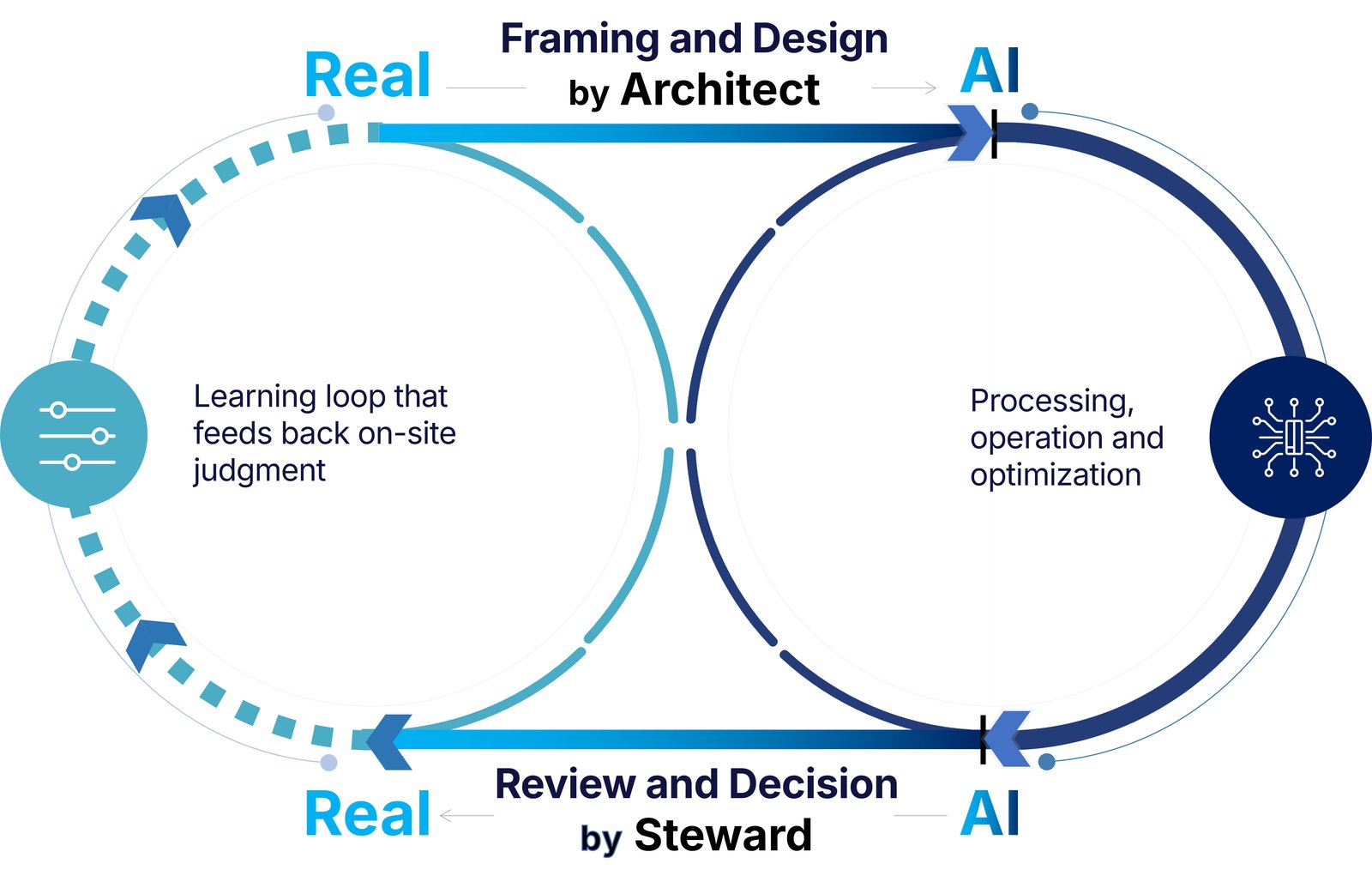
Figure 1. The cycle of work in the age of AI
The "AI Architect" translates the complex realities of the field into objectives, assumptions, constraints, and decision boundaries — the "conditions" within which AI can operate. AI then processes information and optimises options under those conditions. The "AI Steward" reads the resulting output in context, judges its impact on people, equipment, customers, safety, and trust, and decides whether to accept, correct, or stop it. The insight gained there flows back into the next design. That cycle is the true nature of work in the age of AI.
Whether in supply chains, insurance assessment, healthcare operations, or public services, the structure is the same. AI does the executing, but defining the problem, framing the conditions, reading the results, and making the final call always remain human.
This reading aligns with the global trend. BCG's "AI Will Reshape More Jobs Than It Replaces" argues that AI does not replace work but redesigns it. The more AI takes on execution, the more human value shifts toward judgement.
Beyond "AI Will Take Our Jobs"
Since the start of 2026, I have felt firsthand how the anxiety that "AI will take our jobs" has settled ever more thickly over society. Even in the post-session surveys of the generative-AI seminars I have run since early 2025, the share of participants citing the fear that "my own job may disappear" has risen markedly in the 2026 financial year.
Let us find a way out of the binary of "AI takes our jobs" versus "human work disappears." That was my motivation for writing this article.
Drawing on global commentary and discourse, I spent two to three months shaping my own thinking, and discarded countless arguments along the way. If the piece ultimately passed review, I believe it came down to three things.
Three claims that resonated
Roles you can actually picture
Defining the human roles that remain as two roles anyone can picture: the "AI Architect" and the "AI Steward".
Down to a job description
Bringing those roles down to the concrete level of an actual job description, rather than leaving them as abstractions.
The real-to-AI round trip
Stating plainly that moving back and forth between the real world and AI is itself a uniquely human source of value.
This is not a deep dive into any single job; it is a framework addressed to industry and society as a whole. That is precisely why I hope you will use it as a compass — to redefine, within your own operations, where the human work whose market value will rise actually lies, and to carry that through into how you develop your people.
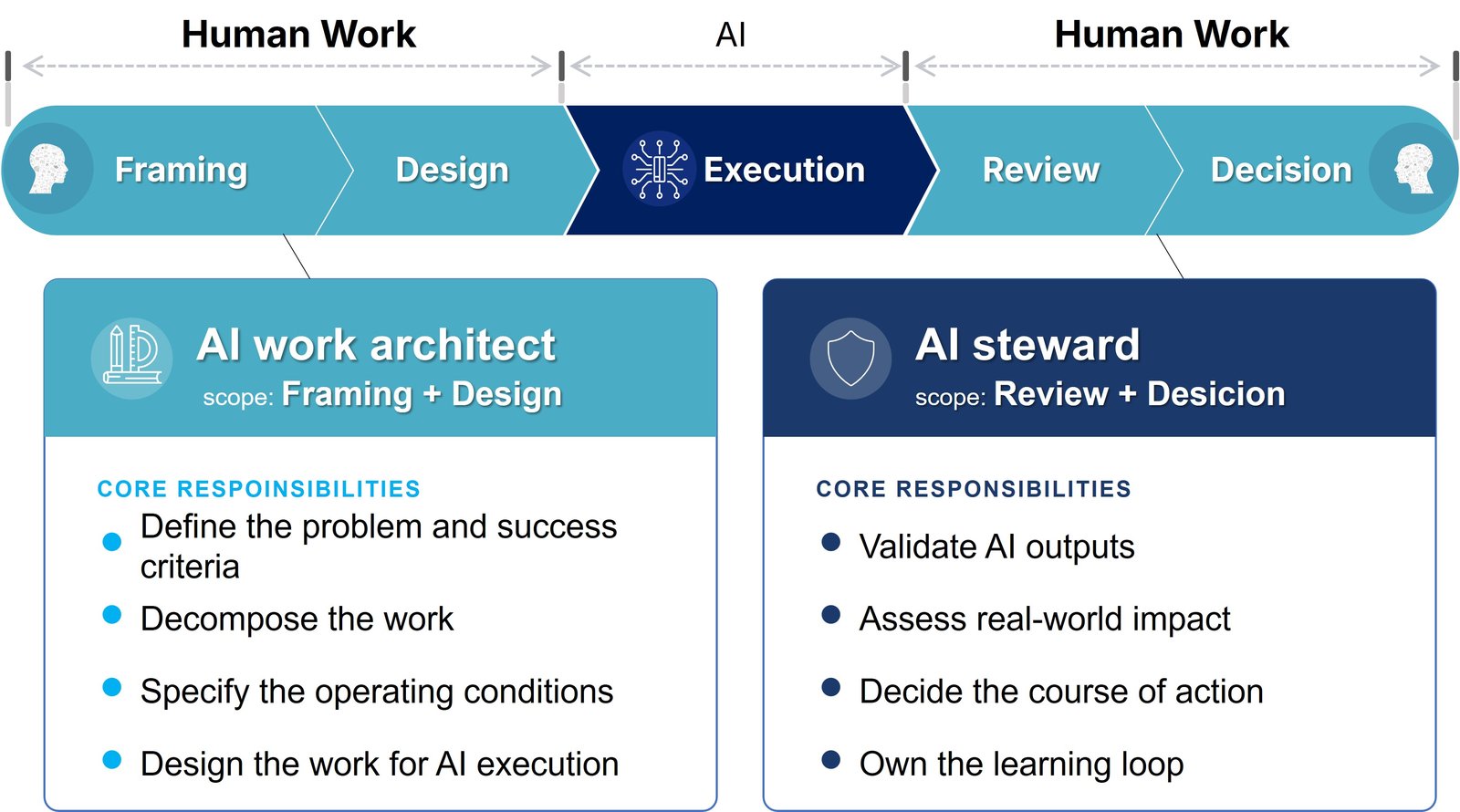
Figure 2. Human roles in the age of AI
And I am convinced that the key to making this real lies in the Toyota Production System, one of Japan's great achievements. Japan has not only the "hawk's eye" for pursuing whole-system optimisation; it has also pioneered, ahead of the world, a scientific approach to breaking "human work" down on the ground and raising the added value of each part. Precisely now, as generative AI prompts us to rethink human work, this industrial-engineering mindset and practice come into their own. Of that I am convinced. I intend to explore new methods for redefining human work in the age of AI in a separate article, apart from this one.
Rather than stopping at a one-sided argument — "jobs will be taken" or "human worth will fall" — the real questions are what we should do instead, and how organisations must change. I want to keep drawing that larger picture, and setting an early direction, together with you.
 World Economic Forum
What Is the Future of Work? Defining Roles for Humans and AI
World Economic Forum
What Is the Future of Work? Defining Roles for Humans and AI
Related Seminar
The AI Frontier — For Leaders Driving Transformation
How do you bring the "AI Architect" and "AI Steward" roles, and the real-to-AI-to-real cycle set out here, into your own operations? This programme helps you move beyond treating generative AI as a mere tool, redesign the human role, and gain the perspective to become a leader who drives transformation.
View seminar details →